Storytelling and Narrative Skills in Two Languages
By Lindsey Carleton, MA, CCC-SLP
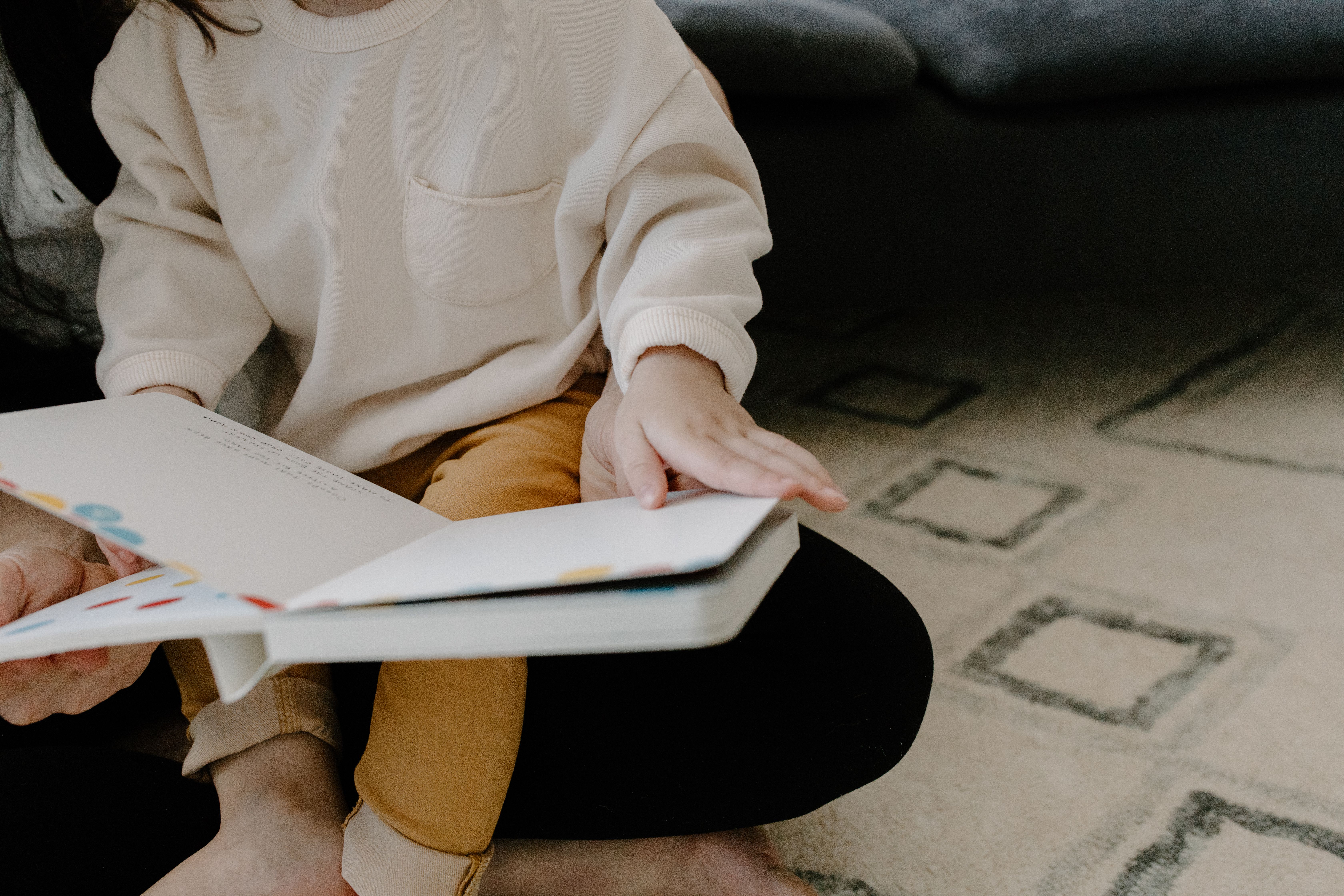
Your 4-year-old sits beside you holding a wordless picture book — no text, just vibrant illustrations of a child, a dog, and a garden full of surprises. “Tell me the story,” you say in Spanish. He turns the page slowly, pointing: “La niña ve a un perro. El perro está en el jardín. Hay flores de muchos colores.” You add nothing, correct nothing. He finishes, clutching the book to his chest. “I made that story,” he says, proud.
That moment — when your child realizes he can create narrative from images, sequence ideas, and hold a listener’s attention — is the moment storytelling becomes real. And that moment is one of the best predictors of later reading success, especially for bilingual children.
In my practice, I’ve noticed something powerful: children who develop strong narrative skills in either language early on tend to become stronger readers in both languages later. Narrative isn’t just entertainment — it’s a cognitive skill that organizes thought, builds vocabulary in context, and creates the mental scaffold that reading requires. For bilingual children, narrative development across both languages is less like learning two separate stories and more like building the same mental architecture twice, in different languages.
Here’s how to deliberately nurture storytelling skills in Spanish and English from the toddler years forward — and why it matters far more than most parents realize.
Why Narrative Skills Predict Reading Success
Before we talk about how to build storytelling, let’s understand why it matters so much.
Narrative is the bridge between spoken and written language. Children who can tell stories — organize events in sequence, include details, and sustain a narrative thread — have already done most of the cognitive work that reading requires. They know that language can hold a complete thought. They can anticipate what comes next. They understand cause and effect.
Research on bilingual literacy shows that narrative skills in one language actually transfer to the other language, even if vocabulary doesn’t. A child who can tell a sequenced story in Spanish has developed the conceptual architecture that will support storytelling and eventually reading in English too.
Narrative builds vocabulary in meaning-rich contexts. Stories embed words in situations, relationships, and emotional content. A child learns “perro” not as an isolated word but as “the perro who ate the food” or “the perro who loves the niña.” That context makes the word stick harder and longer.
Narrative develops executive function. Telling a story requires holding multiple pieces of information in mind, sequencing them logically, and adapting the telling based on your listener’s reactions. These are skills that show up in reading comprehension, writing, and academic thinking.
Wordless Picture Books: The Foundation
The easiest entry point to narrative building is wordless picture books. These books show events through illustration alone, which means your child does all the language work. No script to memorize, no pressure to read — just images and their own language production.
How to use wordless books:
-
Choose books with clear sequences: “First…, then…, finally…” is the natural story arc
-
Let your child do the talking. You ask questions and listen: “What’s happening here? Why do you think she’s doing that? What happens next?”
-
Resist the urge to tell the story. Your child’s interpretation is the whole point
-
For younger toddlers (2-3), simplify: “Where’s the dog? What’s she doing?”
-
For preschoolers (3-5), deepen: “Why do you think that happened? How do you think the character feels?”
Excellent wordless books to start with:
-
Journey by Aaron Becker
-
Tuesday by David Wiesner
-
The Snowman by Raymond Briggs
-
Sector 7 by David Wiesner
-
Good Dog, Carl by Alexandra Day (shows events through illustration)
Use these in both languages. Read the wordless book in Spanish once, in English another time. Your child will tell slightly different versions each time — that variation is actually a sign of language flexibility, not confusion.
”Tell Me What Happened”: The Retelling Routine
One of the most powerful narrative routines I recommend is built around real events in your child’s day.
At pickup from preschool or after a trip: “Tell me what happened today. Tell me the whole story.” Then you listen — in Spanish or English, mixed or pure. Your child strings together the events: “I got there and played with blocks and we had snack and then recess and Ms. Rosa read a story and I made a painting.”
That rambling recitation is exactly narrative practice. You’re asking your child to:
-
Sequence events in the order they happened
-
Hold attention long enough to complete a thought
-
Use language to reconstruct experience
What to do during retellings:
-
Ask follow-up questions in the minority language: “¿Con quién jugaste? ¿Qué color tenía la pintura?” Even if your child answers in English, you’re modeling the Spanish narrative structure
-
Add small details back: “So you built a red tower with Diego, and then you had a snack of crackers and cheese?”
-
Celebrate the story itself: “What a great story! You told me exactly what happened”
-
Resist correcting grammar or fact-checking. The narrative frame is what matters
This retelling becomes even richer when you build it into a weekly family routine: Sunday dinner, you go around the table and each person tells the story of their week. In bilingual families, this is gold — children hear narrative in both languages, and they practice producing it.
Family Storytelling Traditions: The Strongest Foundation
Some of the most bilingual-confident children I work with come from families where storytelling is embedded in culture and ritual. This might look like:
Stories about family history. “Cuando mi abuela era pequeña en México…” Tell the stories of grandparents, great-grandparents, why your family came to where you live, favorite family moments, funny stories about your child’s birth. These stories anchor language to identity. They also give children a repertoire to retell — they naturally repeat family stories they love.
Bedtime story rituals. A parent or grandparent tells the same story over weeks or months. “Cuéntame de la princesa otra vez.” Children memorize these stories and eventually retell them to siblings, stuffed animals, or other family members. Familiarity builds confidence for production.
Stories rooted in cultural traditions. Día de Muertos stories, Christmas stories, stories tied to holidays or celebrations your family observes. These stories carry cultural meaning alongside language.
When storytelling is woven into family fabric — not a separate “educational activity” but something that just happens at dinner or bedtime — children absorb the narrative structure naturally.
Sequencing Games: Building the Narrative Scaffold
While picture books and retellings build narrative bottom-up, sequencing games build it top-down — teaching children to think in sequences.
Physical sequencing games:
-
Print or draw 3-4 sequential pictures (getting ready for school: wake up, eat breakfast, get dressed, go to car). Shuffle them. Child puts them in order and tells the story.
-
Use toy figures to act out simple sequences: “The dog runs, the cat jumps, the ball rolls.” Child narrates or recreates the sequence.
Language-based sequencing:
-
“First we get dressed. Then we eat. Then we go to school.” Ask: “What comes first? What happens next?”
-
Read stories and pause: “What do you think happens next?”
Sequencing with Lego or blocks:
- Your child builds a structure. They narrate: “First I put this block here. Then I added another one. It’s a tower.”
These games teach children that events have an order, that language describes that order, and that the same events can be told different ways depending on emphasis.
Bilingual Narrative Development: Why It Looks Different
Here’s something important: bilingual narratives often develop at different paces across the two languages. Your child might tell rich, complex stories in English at age 4 but still use simple two-word phrases in Spanish. Or the reverse — Spanish narratives might flow while English stays simple.
This is completely normal.
The child with a stronger exposure to English (or stronger emotional connection to an English-speaking parent) will likely develop English narrative structures first. That doesn’t mean Spanish narrative isn’t developing. It means narrative skill is tied partly to language dominance.
The encouraging news: once narrative structure is solid in one language, it accelerates in the other language, even if vocabulary is slower. The mental architecture transfers. A child who knows how to organize a story in English can apply that framework to Spanish quickly, filling in the Spanish vocabulary as it comes.
If you’re concerned about a significant gap, support narrative in the minority language specifically: more wordless books in Spanish, more retellings in Spanish, more family stories told in Spanish. Narrative skill is one of the most transferable language domains there is.
When Your Child Won’t Narrate: Gentle Nudges
Some children are natural storytellers by age 3. Others are quiet observers who don’t narrate much until age 5 or 6. Both are fine. But if you want to encourage more narrative production without pressure:
Narrate for them at first. You tell the story of what you’re seeing together: “The dog is running to the tree. Now he’s playing with a ball. A butterfly is coming! Look!” After weeks of hearing you narrate, many children start narrating alongside you, then gradually take over.
Use predictable books. Stories with repeating structures like Brown Bear, Brown Bear, What Do You See? or _Dear Zoo_are easier for children to “read” and retell because the pattern is so strong.
Make it collaborative. You start the story, your child finishes sentences: “The girl went to the… [child says: park!] and she saw a… [child says: dog!]”
Keep it low-stakes. Never force a child to tell a story. The goal is building confidence and comfort, not performance.
Key Takeaway: Narrative Is the Gateway to Bilingual Literacy
Storytelling isn’t a separate activity you add to your bilingual routine — it’s the foundation everything else builds on. Children who develop strong narrative skills in the early years become readers who understand that texts hold complete thoughts, who anticipate what comes next, and who eventually write stories of their own. For bilingual children, narrative development across both languages creates cognitive flexibility and language confidence that shows up across learning domains.
Start with wordless books. Build retelling routines into your day. Tell family stories at dinner. Play sequencing games. Let your child create narratives from image and experience. Notice when narrative structure appears in one language and trust that it’s building in the other. These practices transform Spanish and English from separate subjects into unified ways of thinking and creating.
For curated wordless book lists by age, printable story sequencing cards, and family storytelling prompts in Spanish and English, download our free bilingual resources guide. And for a complete year-long framework that builds narrative alongside vocabulary, social skills, and emerging literacy, the Palabra Garden 12-Month Bilingual Curriculum includes monthly storytelling themes, book pairing suggestions, and conversation scripts that deepen narrative development.
Related reading: Spanish Emerging Literacy — Building Pre-Reading Skills Before Kindergarten | Spanish Through Pretend Play and Imagination Games
About the Author
Hi, I’m Lindsey Carleton, MA, CCC-SLP, a bilingual speech-language pathologist with more than 11 years of experience and a fellow toddler mom. I created Palabra Garden to support families who want intentional, play-based learning at home.
Through my work as an SLP, I’ve seen how powerful early language, social-emotional development, and hands-on learning can be for toddlers and preschool-aged children. Palabra Garden brings those same principles into your home with bilingual activities, preschool curriculum ideas, and simple strategies that support growing minds.
I believe children learn best through connection, curiosity, and everyday moments of discovery.