Spanish Bath Time: 25 Words and Phrases to Use Every Night
By Lindsey Carleton, MA, CCC-SLP
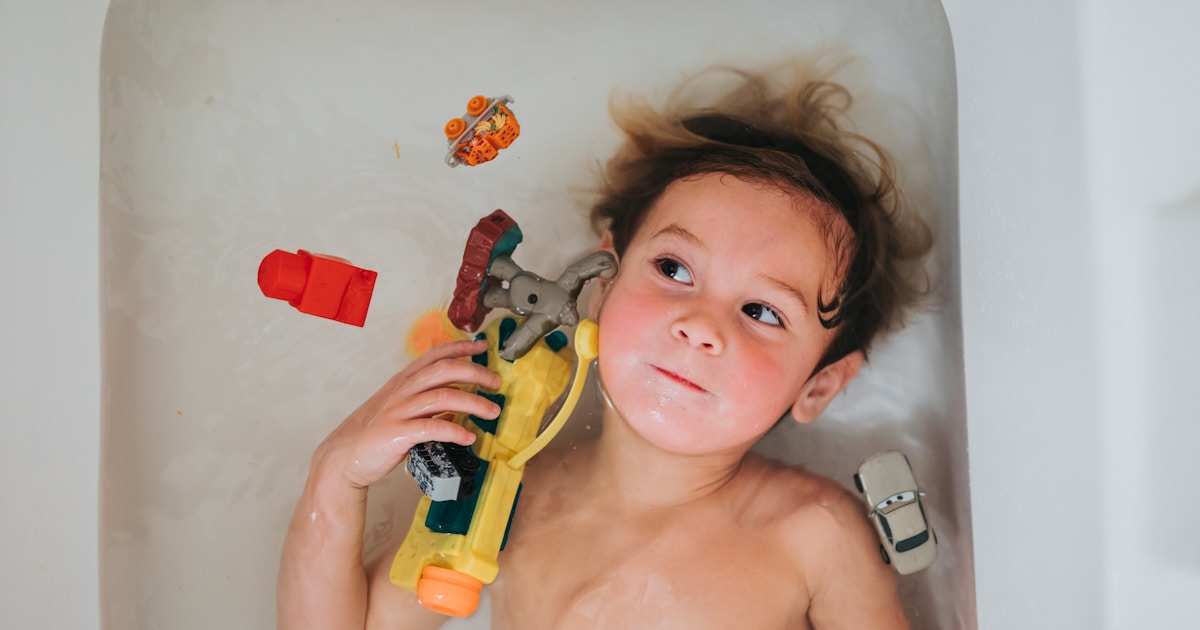
The best part? Bath time is already a routine. You don’t need to carve out special teaching time. You just swap the language you’re using for the five to fifteen minutes you’re already spending getting your child clean.
Let me walk you through 25 essential Spanish words and phrases for bath time, organized by what’s actually happening in that tub.
Getting Started: Bath Time Setup (5 Phrases)
Before you even touch water, you’re setting the stage. These phrases let your child anticipate what’s coming and build vocabulary from the first moment.
La hora del bano (Bath time) — Use this as your opening announcement. Toddlers thrive on predictability, and signaling the transition in Spanish primes their brain that Spanish is about to happen.
Vamos a banuarnos (Let’s take a bath) — This is future-oriented and includes your child (“we’re going to bathe ourselves”).
Quitarse la ropa (Take off your clothes) — Narrate the action as it happens. Your toddler doesn’t just hear the phrase; they experience it.
El agua esta caliente (The water is warm) — Talk about temperature. Toddlers are sensory learners. Warm water is immediately real to them.
Cuidado, el agua esta muy caliente (Careful, the water is very hot) — Safety language is vocabulary too, and it teaches caution.
Body Parts in the Bath (8 Words)
This is where bath time becomes a full sensory vocabulary lesson. Every time you wash, you’re labeling.
La cabeza (Head) — Wash the head, say the word. Repeat it. Your child starts to make the connection between the Spanish word and the body part being scrubbed.
Las orejas (Ears) — Toddlers find their ears fascinating in water. Use that natural attention to build vocabulary.
Los ojos (Eyes) — Be extra careful with water here, but definitely label them.
La nariz (Nose) — Another favorite for toddlers. They love touching their own nose and understanding it has a name in Spanish.
La boca (Mouth) — Teach this while brushing teeth or rinsing.
Los brazos (Arms) — Great for scrubbing actions.
Las manos (Hands) — Wash hands, sing in Spanish, build the connection.
Los pies (Feet) — Tickle and wash, creating a playful memory associated with the Spanish word.
Action Verbs: What You’re Actually Doing (8 Verbs)
Verbs are the engine of language. Bath time is packed with actions, so these verbs will come up repeatedly and naturally.
Lavar (To wash) — “Vamos a lavar los brazos.” This is your most frequent verb. Your child hears it and sees it happening simultaneously.
Enjuagar (To rinse) — “Enjuagamos el cabello.” The action of water pouring is immediately clear.
Salpicador (To splash) — Watch your toddler’s face light up when you say “Ahora salpicamos!” (Now we splash!). This is pure joy plus vocabulary.
Verter (To pour) — If you have cups or containers in the tub, pour water and narrate. “Estoy vertiendo agua.” (I’m pouring water.)
Mojarse (To get wet) — “Te estas mojando.” (You’re getting wet.) Immediate sensory feedback.
Secarse (To dry off) — “Nos secamos con la toalla.” (We dry off with the towel.) The transition to getting out is half the vocabulary lesson.
Jugar (To play) — “Jugamos con los juguetes del bano.” (We play with the bath toys.)
Flotador (To float) — “Mira, el patito flota!” (Look, the duck floats!)
Bath Toys and Water Words (4 Words)
El agua (Water) — The most basic but essential. Say it constantly. Your child will absolutely learn this one because it’s everywhere in the bath.
El pato (Duck) — If you have a rubber duck, name it. Toddlers love ducks. The word sticks.
Las burbujas (Bubbles) — Bath bubbles are mesmerizing. Label them repeatedly. “Mas burbujas!” (More bubbles!) is a phrase you’ll hear your toddler request.
La toalla (Towel) — Essential end-of-bath vocabulary. “Necesitamos la toalla.” (We need the towel.)
Why Bath Time is the Hidden Gem of Bilingual Parenting
Bath time hits three critical conditions for language acquisition: context, repetition, and no pressure. Your child isn’t being tested. They’re just experiencing Spanish words connected to real, sensory objects and actions happening right in front of them.
The water, the warmth, the toys, the physical sensations — all of it creates neural pathways that connect Spanish words to meaning without any explicit teaching. This is how toddlers learn naturally.
Plus, bath time is consistent. Every single night (or every other night), you’re in that tub. That daily repetition is what builds actual, usable vocabulary. You’re not scrambling to find time for bilingual exposure. You’ve already built it into something you do anyway.
How to Make Bath Time Work in Your Bilingual Home
Start with five to seven words. Pick the ones that matter most to your family. If your child loves splashing, focus on splash vocabulary first. If they’re obsessed with ducks, label the duck relentlessly.
Don’t worry about teaching every word perfectly. You’re going to repeat these words dozens of times over the coming weeks and months. The first time your toddler hears “lavar,” they might not register it. The twentieth time, it sticks.
Make bath time playful, not educational. Your job isn’t to quiz your child on body parts. Your job is to narrate what’s happening with genuine joy and presence. When you’re relaxed and enjoying the routine, your child is too, and they learn faster.
For a comprehensive guide to building consistent bilingual routines like bath time, check out our article on bilingual bedtime routines. You’ll find even more structured phrases and tips for making nighttime in your home a Spanish-language window.
If you’re looking to expand your child’s overall bath and hygiene vocabulary, our guide to teaching Spanish at mealtimes uses the same philosophy of embedding language into daily routines. The same technique works for every part of your day.
And if you’re worried about not having enough Spanish words to teach throughout the day, download our free bilingual resources guide. It includes vocabulary lists for common routines, so you always have something to work with.
Ready to Build a Complete Bilingual Program?
Bath time vocabulary is just one piece of a comprehensive bilingual approach. If you’re raising a child ages 2 to 5 in English and Spanish, you need a system that covers vocabulary building, routine integration, and age-appropriate activities across your entire week.
Our 12-Month Bilingual Curriculum includes complete vocabulary lists for every daily routine (bath, meals, getting dressed, bedtime), ready-to-use Spanish games and activities, and a structured approach to building language naturally alongside your child’s development. It’s designed for parents who want to raise truly bilingual children without needing to be fluent themselves.
Get the 12-Month Bilingual Curriculum today and start building bath time as your secret language advantage.
Your Bath Time Spanish Starts Tonight
You don’t need fancy materials or perfect pronunciation. You just need to show up, be present, and narrate bath time in Spanish. Night after night, your toddler’s brain is absorbing these words, connecting them to real experiences, and building a foundation for bilingual fluency.
Start with “La hora del bano” tonight. Introduce five body parts. Play with the water and narrate what you’re doing. Your child might not repeat it back to you right away — that’s completely normal. But trust the process. You’re planting seeds that will grow into genuine Spanish language ability.
That’s the quiet power of routine-based bilingual parenting. You’re not adding to your stress. You’re transforming something you already do into your most valuable teaching moment of the day.