Halloween Costume Vocabulary — From Princesa to Dinosaurio
By Lindsey Carleton, MA, CCC-SLP
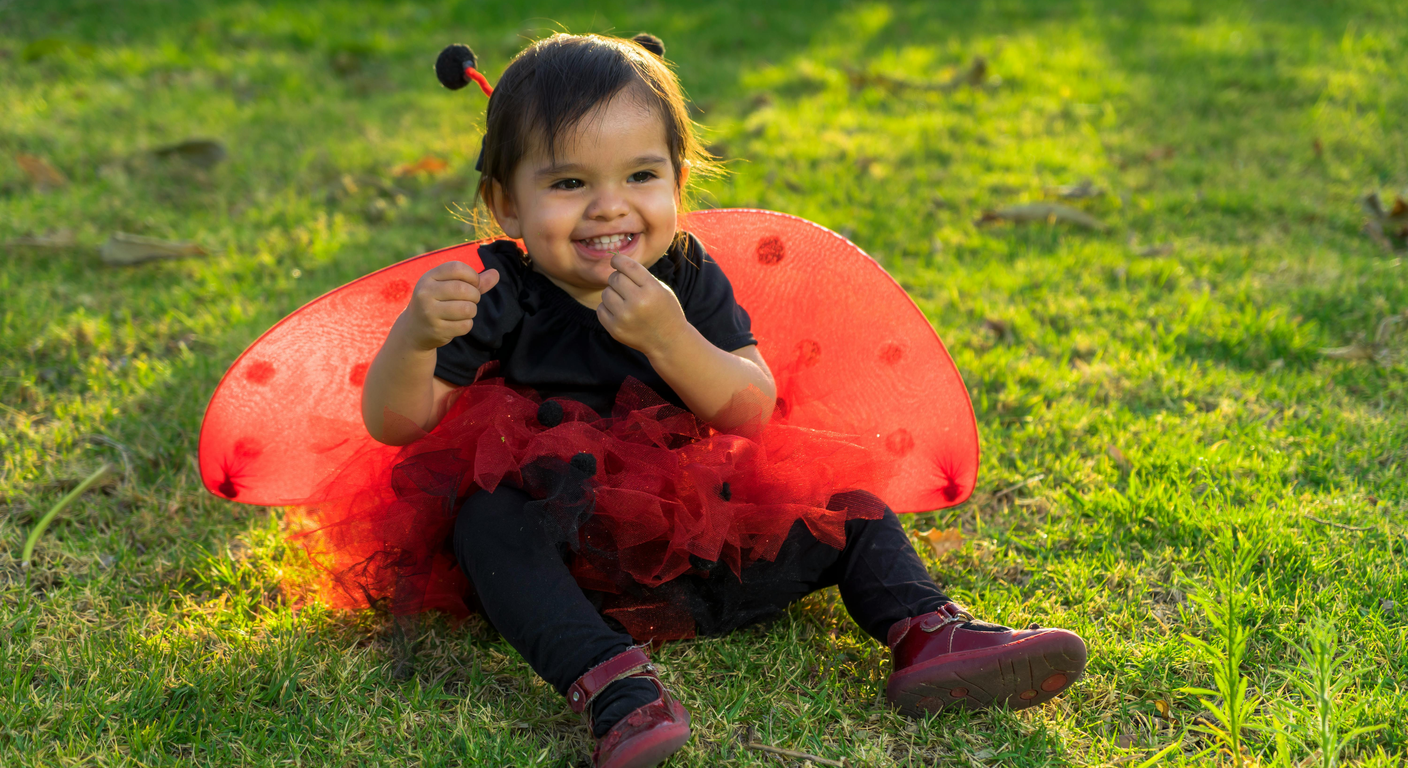
By the time you read this it’s probably too late to buy a costume. That’s fine. Whatever your toddler is wearing on Friday — store-bought princess, hand-me-down dinosaur, or a sheet with eye holes — is also a vocabulary lesson if you know thirty words.
I’m a speech-language pathologist, and I like Halloween for the same reason I like grocery shopping: it’s an annual ritual full of repeated, concrete, high-interest nouns that your kid will hear in real context for an entire week. Below are thirty Spanish costume words, grouped by category, with one usable phrase for each. You don’t need all thirty. Pick the five or ten that apply to what your kid’s actually wearing or seeing this year.
Classic Halloween figures
1. la bruja — the witch “Mira, una bruja con su escoba.” (“Look, a witch with her broom.”)
2. el fantasma — the ghost “¡Buuu! Soy un fantasma.” (“Boo! I’m a ghost.”)
3. el esqueleto — the skeleton “El esqueleto tiene huesos blancos.” (“The skeleton has white bones.”)
4. el vampiro — the vampire “El vampiro tiene dientes largos.” (“The vampire has long teeth.”)
5. el monstruo — the monster “¿Es un monstruo bueno o un monstruo malo?” (“Is it a good monster or a bad monster?”)
6. la momia — the mummy “La momia camina así, despacio.” (“The mummy walks like this, slowly.”)
7. el zombi — the zombie A loaner word, pronounced thom-bee in Spain or som-bee in Latin America. Save this one for older kids — under four can find zombies genuinely scary.
8. la calabaza — the pumpkin (also a costume) “Eres una calabaza pequeñita.” (“You’re a tiny pumpkin.”)
9. el murciélago — the bat A fun word to teach because of how it sounds: moor-see-EH-lah-go. Toddlers love it for the rhythm.
10. la araña — the spider “La araña tiene ocho patas.” (“The spider has eight legs.”)
Royalty and fairy-tale costumes
11. la princesa — the princess “¿De qué color es tu vestido de princesa?” (“What color is your princess dress?”)
12. el príncipe — the prince “Un príncipe valiente.” (“A brave prince.”)
13. la reina — the queen “La reina tiene una corona.” (“The queen has a crown.”)
14. el rey — the king “El rey lleva una capa roja.” (“The king is wearing a red cape.”)
15. el hada — the fairy A grammatically funny one: feminine but takes el because it starts with a stressed a. Don’t sweat it; toddlers will figure it out long before grammar matters.
16. la sirena — the mermaid “La sirena vive en el mar.” (“The mermaid lives in the sea.”)
17. el unicornio — the unicorn “El unicornio tiene un cuerno mágico.” (“The unicorn has a magic horn.”)
Animals — always a top toddler pick
18. el dinosaurio — the dinosaur “¡Rooar! El dinosaurio tiene hambre.” (“Roar! The dinosaur is hungry.”)
19. el león — the lion “El león dice rugir.” (“The lion roars.”) In Spanish, rugir is the verb for the sound itself.
20. el tigre — the tiger “El tigre es anaranjado y negro.” (“The tiger is orange and black.”)
21. el conejo — the rabbit “El conejo salta así.” (“The rabbit hops like this.”)
22. el gato — the cat “El gato negro es de Halloween.” (“The black cat is for Halloween.”)
23. el perrito — the puppy A great two-year-old costume word. Easy to say, easy to recognize.
24. la mariposa — the butterfly “La mariposa tiene alas bonitas.” (“The butterfly has pretty wings.”)
Heroes and jobs
25. el bombero / la bombera — the firefighter “El bombero apaga el fuego.” (“The firefighter puts out the fire.”)
26. el policía / la policía — the police officer “El policía ayuda a las personas.” (“The police officer helps people.”)
27. el doctor / la doctora — the doctor “La doctora cura a los niños.” (“The doctor heals children.”)
28. el astronauta / la astronauta — the astronaut “El astronauta va al espacio.” (“The astronaut goes to space.”)
29. el superhéroe / la superheroína — the superhero “Mi superhéroe favorito es…” (“My favorite superhero is…”)
30. el pirata / la pirata — the pirate “El pirata busca un tesoro.” (“The pirate is looking for a treasure.”)
How to actually use these words across the week
Thirty words is a lot. The mistake I’d want you to avoid is sitting your kid down and quizzing her. That’s not how toddlers learn language. Vocabulary at this age sticks when it shows up in the natural moments of the day. Here’s a one-week plan to fold these into your existing Halloween chaos.
Monday — costume try-on. Whichever costume your kid is wearing, learn its Spanish word and repeat it ten or twelve times during the try-on. “¿Dónde está la princesa? ¡Ahí está la princesa! Mami también es una princesa.” Over-the-top is good.
Tuesday — reading. Open any Halloween picture book. Every time you turn a page, name one costume in Spanish. You don’t have to translate the story. You just have to point and say “calabaza, bruja, fantasma” when they appear.
Wednesday — drawing. “Vamos a dibujar un esqueleto.” Get a piece of paper and draw it together. Drawing while saying the word activates the part of the brain that ties motor planning to language — it’s a real trick, not just a craft.
Thursday — pretend play. Put on the costume early. Do a five-minute pretend trick-or-treat at the front door. Use the costume word every time. “El dinosaurio quiere dulces.”
Friday — the real thing. On Halloween itself, you’ll naturally see ten or fifteen other costumes on the sidewalk. Narrate. “Mira, ese niño es un bombero.” This is the best vocabulary moment of the year — your kid will see the word matched to a real person every thirty seconds.
Saturday — debrief. “¿De qué te disfrazaste anoche?” (“What did you dress up as last night?”) The day after Halloween is a gold mine for vocabulary review because your kid will want to talk about it for a week.
Forty repeated exposures over six days is enough for a three-year-old to lock in five or six new words. That’s more vocabulary than most “Spanish for kids” apps deliver in a month.
A note on costumes and culture
A real principle worth keeping in mind: Halloween costumes are a place where the line between dressing up and dressing up as someone else’s identity gets crossed easily. Toddlers are too young to engage with this directly, but you’re not. A child dressed as a pirate is fine. A child in a “mariachi costume” or a “Day of the Dead costume” raises real questions — even at age four, and even if the intent is to honor. I won’t write that whole essay here; I’ll just flag it. If you’re considering one of those, our Día de los Muertos primer walks through what is and isn’t a costume.
If you want the rest of the year planned
A theme week like Halloween is fun because the world hands you the vocabulary. The hard part is November 1 — when there’s no holiday and you’re staring at a Tuesday and wondering what to teach. That’s what the 12-month bilingual curriculum is designed to do: hand you a weekly theme so you’re never starting from zero again. The first free week is at the freebie page if you’d like to see how it’s structured.
Have fun on Friday. Take pictures. Use the words.
— Lindsey