Spanish 'L' Sound — When to Expect It and How to Encourage It
By Lindsey Carleton, MA, CCC-SLP
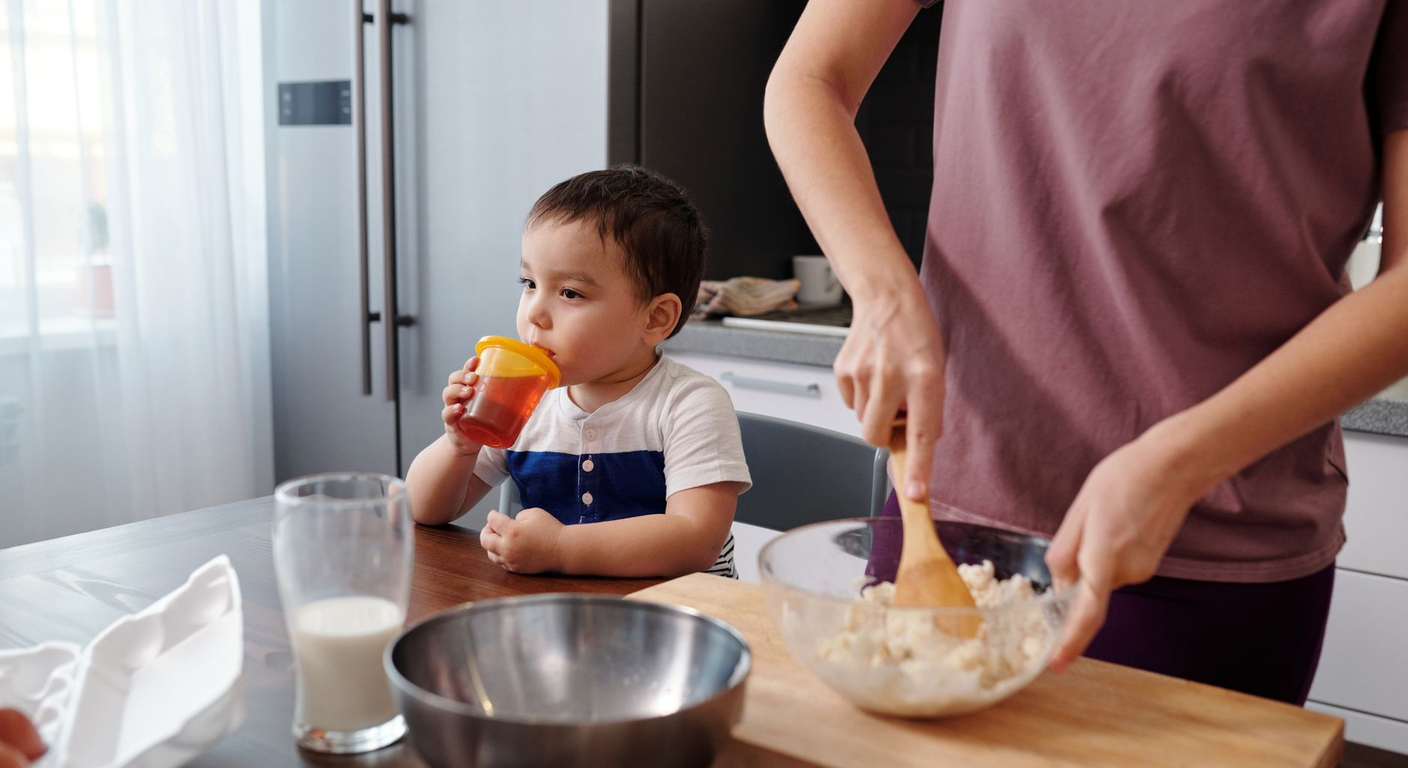
You’re at the breakfast table and your three-year-old asks for yeche instead of leche. Or yibro for libro. Or maybe she’s saying leche but the L sounds darker, more like the way you’d say “all” — and you’re wondering if that’s a Spanish L or just an English L wearing a Spanish hat.
I’m a speech-language pathologist, and the L sound is one of the most-asked-about sounds in bilingual households. It’s tied for first place with the rolled R. Below is what I actually tell parents — what’s normal, what’s worth flagging, and what you can do at the kitchen table without turning every meal into a speech lesson.
The Spanish L vs. the English L — they are not the same sound
This is the part most parents don’t realize: the L in Spanish and the L in English are different sounds. They look identical in writing. They feel almost identical to a casual ear. But your mouth does something subtly different for each one, and bilingual kids have to figure out which version belongs where.
The Spanish L is what linguists call a “light L.” The middle and back of the tongue stay relatively flat. The tip touches the alveolar ridge (right behind your upper front teeth). Air flows around the sides of the tongue cleanly. It’s a crisp, forward sound.
The English L — especially in syllable-final positions like “ball,” “feel,” “milk” — is a “dark L.” The back of the tongue pulls up toward the roof of the mouth, giving the sound a slight uh color. Say “ball” slowly and notice how the L almost has a vowel inside it.
For a bilingual toddler, both versions have to coexist. The brain has to learn that libro uses the light L and milk uses the dark L. Most kids sort this out without conscious effort — but the sorting takes time, and during the sorting period you’ll hear all kinds of fascinating substitutions.
Typical age of acquisition
Here’s the rough timeline I’d give you, based on the research on Spanish phonological development (Goldstein and Iglesias, Bedore and Peña, and others). Bilingual kids fall in roughly the same range as monolingual Spanish-speaking kids for the L sound, with a little more variability.
- Ages 2–3: The Spanish L is being acquired. Substitutions are extremely common and not concerning. The most frequent substitution is /j/ (“y” sound) for /l/ — so leche becomes yeche, libro becomes yibro. Swapping a liquid sound like /l/ for a glide like /j/ is called liquid gliding, and it’s one of the most common, expected patterns in young Spanish-acquiring kids. (Don’t confuse it with yeísmo, which is an unrelated adult accent feature — the merging of the ll sound with y — not a child substitution at all.)
- Age 3: Many bilingual kids are starting to produce L correctly in initial position (the start of a word — leche, libro, luna).
- Age 4: L is considered fully acquired in Spanish — earlier than the English L (ASHA Spanish Phonemic Inventory, Acevedo 1993). Most bilingual kids produce it correctly in initial and medial positions (pelota, color). Final-position L in Spanish is rarer because Spanish words don’t end in L as often as English words do, but words like árbol and fácil should be clean.
- Age 5: Persistent substitutions of /l/ after this age are worth a conversation with an SLP.
For comparison, the English L is considered fully acquired around age 5–6, with some research suggesting up to age 6 is still within the normal range. So if your bilingual four-year-old says milk as miwk, that’s also normal English development — not a sign of bilingual interference.
Normal substitutions
Here’s the list of substitutions I’d consider squarely within normal range for a 2–4 year old bilingual child. None of these are a disorder in this age window.
- /l/ → /j/ (“y”): leche → yeche. By far the most common.
- /l/ → /w/: leche → weche. Common around age 2.
- /l/ → /n/: leche → neche. Less common but still typical at 2.
- /l/ → /d/: leche → deche. Rare but documented.
- Dark English L bleeding into Spanish words: leche sounds like uh-eche. This isn’t a substitution so much as a phonetic blend, and usually resolves by age 4.
What’s not a typical substitution — and is worth flagging if it’s persistent:
- /l/ being dropped entirely: leche → eche. Dropping the initial consonant while keeping both syllables (le-che → e-che) is called initial (prevocalic) consonant deletion. Unlike the benign patterns higher up this page, this one is considered atypical — it’s not a stage most kids simply pass through — so it’s worth watching, and worth mentioning to an SLP if you’re hearing it with any regularity.
- Glottal stops in place of L: a kind of “catch” sound in the throat instead of the tongue going up. Worth a consult if it’s frequent past age 3.
- Substitutions happening in both languages with multiple sounds, not just L. That’s a broader phonological pattern worth assessing.
What you can do — practical, low-pressure stuff
You cannot teach a sound by drilling a two-year-old. You also can’t speed up the developmental timeline meaningfully. What you can do is provide rich, clear, high-frequency exposure to the sound and a few low-pressure opportunities to practice. Here’s what I’d actually do at home.
Model, don’t correct. This is the single most important principle for any speech sound at this age. If your three-year-old says yeche, the response is “Sí, leche. Aquí tienes la leche.” Said clearly, slightly slower, with normal intonation. You’re not pointing out the error. You’re providing the correct model, and the child’s brain notices. Direct correction (“No, leche, not yeche”) tends to make toddlers self-conscious without speeding up acquisition.
Pick a few high-frequency L words and use them often. Words you’ll naturally say twenty times a week:
- leche (milk)
- libro (book)
- luna (moon)
- limón (lemon)
- lápiz (pencil)
- lluvia (rain) — note: ll is its own sound, not L, but kids often confuse them
- pelota (ball)
- helado (ice cream)
- animal (animal)
- árbol (tree)
Just hearing leche twenty times a day is the practice. There’s no separate drill needed.
Read books with repeating L words. Picture books with predictable, repeating language are gold for any sound. Anything with La luna, El león, El libro in the title is going to give you five reads of an L sound per page.
Sing songs with L sounds. La cucaracha, Los pollitos, La gallina turuleca. Songs slow the rate of speech and amplify the sound, which makes the L easier for a toddler to hear and copy.
Mirror games for older kids (4–5). Sit in front of a mirror, say la la la la la together, and let your child see her tongue tip touch behind her upper teeth. This is real speech therapy practice, but it works best as a game and only after age four or so. Under four, it usually flops.
When to actually seek help
You should not panic about an L substitution at age two or three. You should consider a consultation if:
- Your child is 5 years old or older and still substituting /l/ in Spanish consistently.
- The substitution is happening in both Spanish and English, and affects multiple sounds, not just L.
- Your child is frustrated by not being understood — by you, by other kids, by teachers. This one matters more than any age cutoff.
- You’re seeing other red flags — limited vocabulary, difficulty understanding directions, or regression of skills. (More on those in how to decode a bilingual speech evaluation report.)
When you do seek help, look for a bilingual SLP if you can — or at minimum, an SLP who will assess your child in both languages. Many monolingual evaluators will misidentify normal Spanish substitutions as English articulation problems, which leads to the wrong kind of therapy and a lot of unnecessary parental worry.
The short version
The Spanish L is a different sound from the English L. Bilingual kids acquire both, in their own time, usually somewhere between ages 3 and 5. Substitutions in the meantime are normal. Modeling, not correcting, is the move. If your child is past 5 and still substituting, or if she’s frustrated, get a bilingual SLP to take a look.
If you want a structured way to give your child more high-frequency exposure to Spanish sounds across the year, the 12-month curriculum is built around weekly themes that recycle the same vocabulary across multiple contexts — which is exactly the kind of repetition that helps sound development. And you can grab a free sample at the freebie page.
— Lindsey