When Your Toddler's Teacher Doesn't Speak Spanish (A Communication Playbook)
By Lindsey Carleton, MA, CCC-SLP
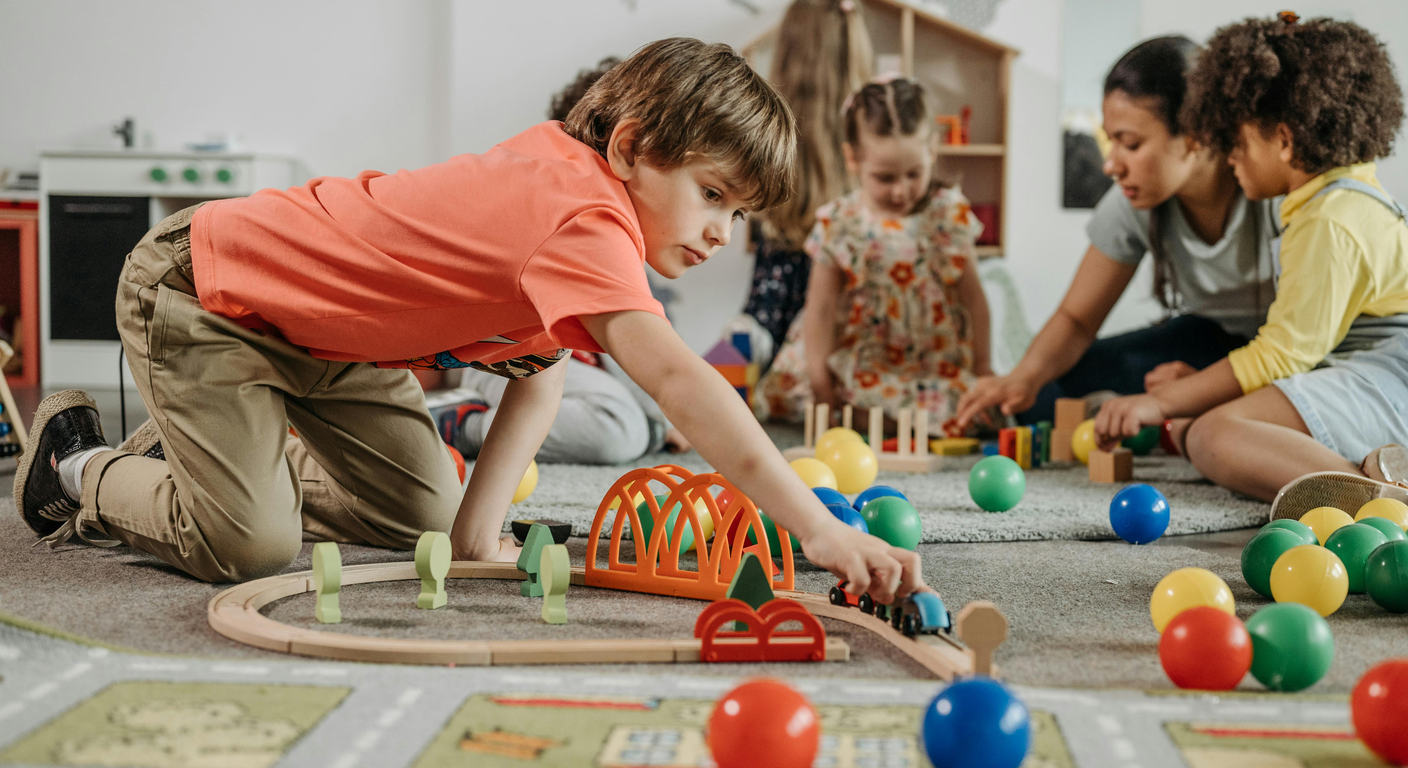
The most common email I get from bilingual parents in September is some version of this: “My toddler started preschool and the teacher said ‘maybe pause the Spanish to help her catch up on English’ — what do I say?”
If you’ve heard a version of this from your child’s teacher, you’re not alone, and you don’t have to abandon your home language plan. Here is the playbook for navigating the conversation — without putting the teacher in defensive mode, without giving up on bilingualism, and without making your toddler the test case.
The misconception you’re probably navigating
The vast majority of monolingual U.S. preschool teachers are not trained in bilingual development. The standard ECE (early childhood education) curriculum spends days on bilingual language acquisition, not weeks. So well-meaning teachers often arrive at “limit the second language” not from prejudice but from a genuine — and incorrect — read of what they were taught.
The misconception: that two languages compete in the child’s brain for finite cognitive real estate, so reducing one will accelerate the other.
The reality: bilingual exposure does not cause speech delays, does not slow English acquisition in any meaningful way past about age 4, and is associated with significant long-term cognitive benefits. The research on this is extremely clear — decades of it. The American Speech-Language-Hearing Association (ASHA) and major pediatric language-research centers align on this. Bilingualism does not need to be paused. Ever.
For the deeper picture, see our will being bilingual delay speech post and our bilingual children myths debunked post.
The conversation script (when the teacher raises a concern)
Don’t argue research with the teacher at drop-off. Use this three-part script instead:
“Thanks for bringing this up — I really do appreciate you watching out for her. Our family has decided to keep her bilingual exposure consistent because it’s part of who we are. Her speech is on track in both languages, and her pediatrician has confirmed that. I’d love to keep working together if you notice anything specific I should know about.”
Three things this does:
- Validates the teacher’s concern — without conceding the premise.
- States the family decision as decided, not debatable.
- Invites future observation rather than future advice.
Most teachers will respect this and move on. Some will push back. If they do, the second-level script is:
“I understand this is something you’ve seen with other families. We’ve talked with her pediatrician and an SLP, and the research supports keeping both languages going. I’m happy to share a one-page summary if it’d be useful.”
If they push past that, you may have a teacher who’s not going to update easily. Don’t escalate. Keep the relationship warm at drop-off and continue your home plan unchanged. Most teachers don’t get involved beyond a verbal suggestion.
Proactive communication (before any concern is raised)
The single best thing you can do at the start of the school year is preempt the question with a positive note. Two or three sentences. Don’t make it a manifesto.
“Hi — wanted to introduce ourselves. We’re a bilingual family; Lucia hears Spanish at home and English at school. She understands both well and is most comfortable speaking English with friends. We’re so glad she’s in your class.”
This three-sentence note gives the teacher:
- The factual setup
- Confidence that your child can navigate the classroom in English
- A warm tone that establishes you as collaborative
Most teachers will respond warmly. You’ve also created a documentary record — the note is in their inbox — that you flagged the bilingual setup positively from day one.
What if the teacher is enthusiastic about Spanish?
Some teachers will respond to your bilingual setup with delight and want to incorporate Spanish into the classroom. This is wonderful and you should encourage it, but with a small caveat: the teacher’s Spanish may be limited. Don’t expect them to teach Spanish; expect them to honor it.
Reasonable things to ask:
- “Could you say buenos días when she comes in?” — easy and meaningful
- “Could you display some Spanish word labels in the room?” — symbolic but real
- “Could you sometimes read a bilingual book at story time?” — moderate ask
Unreasonable things to ask:
- “Could you teach in Spanish 20% of the time?” — not in their training
- “Could you correct her Spanish pronunciation?” — not their competence
- “Could you make sure she speaks Spanish at school?” — not their job
When the school has an explicit “English-only” policy
Some private preschools — and a depressingly large number of public ones — have unofficial or explicit English-only policies. If yours does, you have three choices:
1. Respect the policy at school and double-down at home
Your child speaks English at school, Spanish at home. This is the most common compromise. It works, but you’ll need to be more intentional about Spanish in the hours your child is home awake (typically only 4–5 daylight hours during the school week).
2. Push back on the policy
This is harder. If the policy is unofficial, ask the director for a clarification in writing. The mere act of asking often gets the policy softened. If it’s a formal policy, you can request a conversation with the director about its rationale — bring research, ask questions, keep the tone curious not confrontational.
3. Switch schools
If the policy is rigid and creates real harm — your child is shamed for speaking Spanish, materials are taken away, etc. — switch. There are bilingual and dual-language preschools in most U.S. metropolitan areas. See our Spanish immersion preschool vs dual language vs English school with home Spanish post for the comparison.
A note about teacher turnover
If your child has a teacher who is initially unsupportive of bilingualism, remember: most preschool teachers turn over every 1–3 years. You may simply have a different teacher next fall. Don’t burn bridges over a single year’s interaction.
What I’d put in the cubby
If you want to make life easier for your child during the school day, put a small reminder card in their cubby:
“Lucia is bilingual at home (English/Spanish). She may switch sometimes. That’s healthy. Thank you!”
Even teachers who don’t read it on day one often notice it during cleanup later. The visual cue is more durable than the conversation.
The longer game
Your child will likely have 12+ different teachers across preschool, elementary, and middle school. Some will be enthusiastic about your bilingualism, some indifferent, some quietly disapproving. Your job is to keep the home bilingual rhythm consistent regardless of which type of teacher you draw. By the time your child is in middle school, the school’s role in their bilingual identity is minor; the home role is overwhelming.
For a long-arc view of how to sustain home Spanish across years of school changes, see our how to keep your toddler’s Spanish going after preschool post.
Frequently asked questions
My child’s teacher said my child “isn’t talking much” — is that because of bilingualism?
Almost certainly not. Bilingual toddlers in a new English-only environment often go through a silent period (several weeks to a few months of mostly listening) at the start of school. This is a normal language-acquisition phase and is not a delay. We have a deeper post on the silent period in bilingual toddlers.
Should I keep my child home if the teacher is dismissive of our bilingualism?
Usually no. The classroom environment matters less than what happens at home. Dismissive teachers are unfortunate but rarely cause lasting damage if the home language is strong. Switch only if the environment is actively hostile.
Can I require the teacher to use Spanish phrases with my child?
You can request, not require. Most teachers will accommodate small Spanish phrases (a buenos días, a te quiero) if asked warmly. Larger asks (a Spanish-language activity, daily Spanish conversation) aren’t usually within the teacher’s competence or time.
What if both parents work and the child is at preschool 8+ hours a day?
You have less time at home, so make every Spanish moment count. The high-leverage windows are drop-off, pick-up, dinner, bath, bedtime. See our working parent’s bilingual playbook for the structured version.
Does the teacher need to know we’re working on a 12-month bilingual curriculum at home?
No, unless you want to share. The curriculum is a parent-facing tool; the teacher doesn’t need details.
If you want a structured plan for the home side of the bilingual equation, see the 12-month curriculum. For free, start with our Spanish phrase cards.