How to Teach Your Child Spanish at Home: 5 Simple Strategies
By Lindsey Carleton, MA, CCC-SLP
You don’t need a degree in Spanish, an immersion school, or expensive language programs. With five simple strategies you can start today, you’ll build a foundation that gives your child the lifelong gift of bilingualism.
Whether you’re a heritage speaker wanting to pass on your family’s language, a parent who studied Spanish in school and wants to share it, or someone starting from scratch alongside your child, teaching Spanish at home is more achievable than you think.
As a bilingual speech-language pathologist, I’ve seen these five strategies work across hundreds of families with different backgrounds, fluency levels, and daily schedules. The secret isn’t perfection. It’s weaving Spanish into the moments you already share with your child.
- Anchor Spanish to Daily Routines
The most effective language learning happens when it’s tied to predictable, repeated daily activities. Choose two to three routines where you’ll consistently use Spanish, and keep them the same every day. The repetition is what builds vocabulary and comprehension.
Mealtime Spanish
Mealtimes are ideal because they happen multiple times a day and involve rich, concrete vocabulary. Start by naming foods, utensils, and actions as you prepare and eat together.
Bath Time Spanish
Bath time naturally teaches body parts, actions, and sensory vocabulary.
Bedtime Spanish
A quiet bedtime routine in Spanish creates a calm, positive association with the language.
- Use Music as Your Secret Weapon
Music is one of the most powerful language-learning tools available, and it requires zero fluency on your part. Songs activate memory pathways that spoken language alone doesn’t reach, which is why children (and adults) can remember song lyrics years after learning them.
Build a Spanish music playlist and play it during car rides, playtime, cooking, and transitions. Children absorb pronunciation, rhythm, vocabulary, and grammar through songs without any conscious effort.
Songs to Start With
-
Los Pollitos Dicen — a gentle nursery rhyme about baby chicks (teaches animal vocabulary and caregiving words)
-
Cabeza, Hombros, Rodillas y Pies — Head, Shoulders, Knees and Toes in Spanish (teaches body parts through movement)
-
De Colores — a traditional folk song about colors in nature
-
Un Elefante Se Balanceaba — a counting song about elephants (teaches numbers)
-
Estrellita, ¿Dónde Estás? — Twinkle Twinkle Little Star in Spanish
-
Las Ruedas del Autobús — The Wheels on the Bus in Spanish (teaches action verbs)
Search for “canciones infantiles en español” on your preferred music platform for curated playlists. Artists like Jose-Luis Orozco, Canticos, and 123 Andrés create high-quality bilingual children’s music.
SLP Tip: Don’t just play songs in the background. Sing along, add hand motions, and pause for your child to fill in words. Active engagement with music triples its vocabulary-building power compared to passive listening.
- Read Together in Spanish (Even If Your Pronunciation Isn’t Perfect)
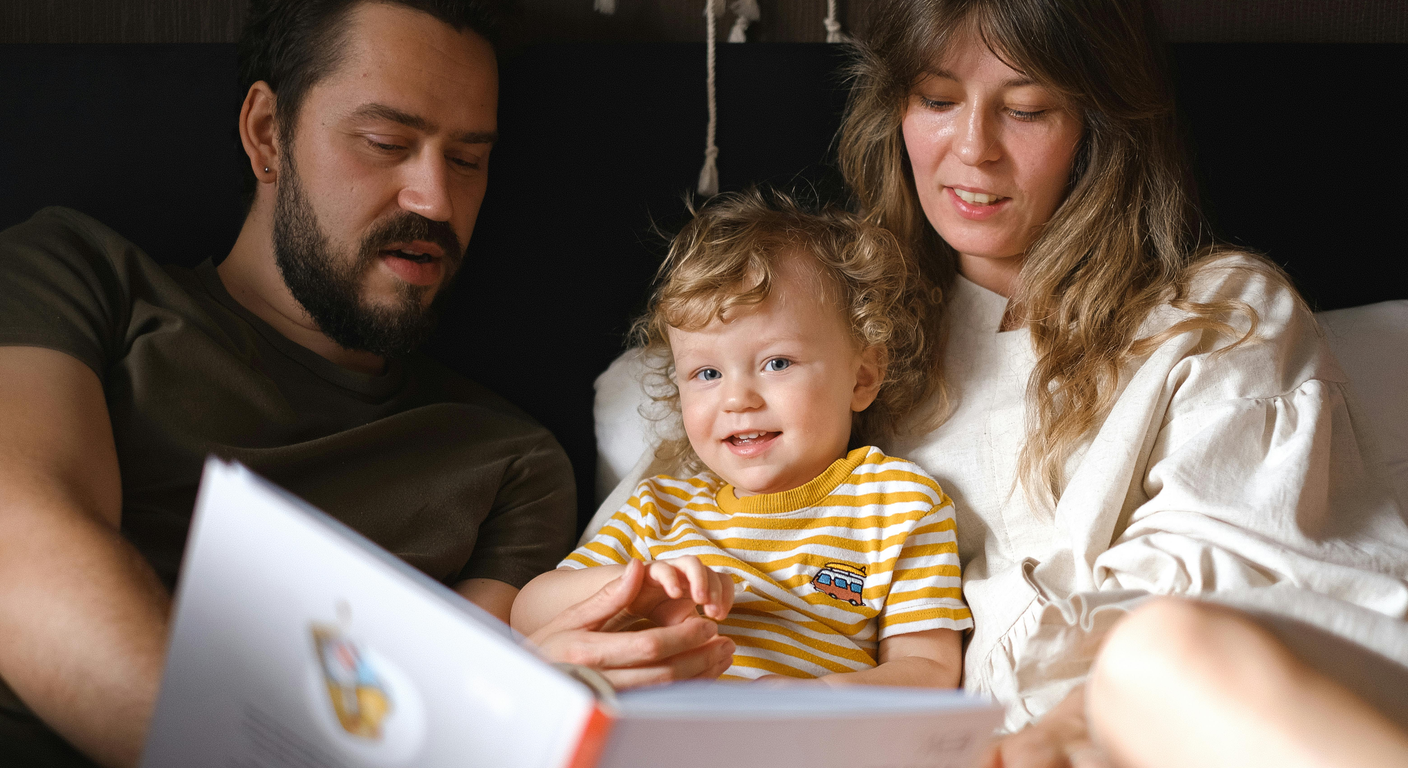
Shared book reading is the single most impactful activity for language development, in any language. Reading exposes children to vocabulary, sentence structures, and narrative patterns they won’t hear in everyday conversation.
You don’t need a huge Spanish library. Start with three to five bilingual or Spanish-language picture books and read them repeatedly. Toddlers thrive on repetition, and each reading deepens vocabulary understanding.
How to Read in Spanish (Even as a Beginner)
Choose books with simple, repetitive text and strong illustrations. For the first reading, focus on naming the pictures rather than reading every word perfectly. Point to the dog and say “perro.” Point to the sun and say “sol.” Your child is learning vocabulary from your labeling, not from perfect story narration.
As you get more comfortable, add phrases: “¿Dónde está el perro? Ahí está el perro.” (Where is the dog? There is the dog.) Ask simple questions: “¿Qué es esto?” (What is this?) and “¿De qué color es?” (What color is it?)
Recommended First Books
-
Brown Bear, Brown Bear / Oso Pardo, Oso Pardo by Bill Martin Jr. — repetitive structure, colors, and animals
-
Goodnight Moon / Buenas Noches, Luna by Margaret Wise Brown — bedtime vocabulary
-
¡Moo, Baa, La La La! by Sandra Boynton — animal sounds (compare English and Spanish versions)
-
My First 100 Words / Mis Primeras 100 Palabras — labeled picture vocabulary
-
De la Cabeza a los Pies / From Head to Toe by Eric Carle — body parts and action verbs
SLP Tip: Don’t worry about your accent. Research shows that any Spanish input, even from non-native speakers, builds your child’s phonological awareness and vocabulary. Your child will also absorb native pronunciation from music, media, and community exposure.
Try Our Free 7-Day Bilingual Challenge
One simple activity per day for seven days. Each activity takes 10 minutes or less and uses strategies just like these. Designed by a bilingual SLP for families at any fluency level.
- Label Your World in Two Languages
Creating a bilingual environment at home gives your child passive language input throughout the day. Every labeled object becomes a mini vocabulary lesson that your child absorbs simply by living in the space.
How to Set This Up
Print or write bilingual labels for common household items and tape them at your child’s eye level. Include both the English and Spanish word with a simple illustration if possible. Focus on high-frequency items your child interacts with daily.
Start with these areas: the kitchen (nevera/refrigerator, mesa/table, silla/chair), the bedroom (cama/bed, almohada/pillow, lámpara/lamp), the bathroom (espejo/mirror, jabón/soap, toalla/towel), and common objects throughout the house (puerta/door, ventana/window, luz/light).
Beyond physical labels, create a Montessori-inspired language shelf with bilingual materials your child can access independently. Include vocabulary cards, bilingual picture books, and manipulatives (like toy food or animals) with bilingual labels.
SLP Tip: When you pass a labeled object, pause and point to it naturally. “Vamos a abrir la puerta. Door. Puerta.” Over time, start asking your child: “¿Qué es esto?” Most children begin reading environmental print before formal reading instruction, and bilingual labels give them a head start in two languages.
- Play in Spanish
Play is your child’s primary learning mode, and it’s where language development happens most naturally. When language is connected to fun, engagement, and social connection, it sticks.
Games That Build Spanish Vocabulary
Simón dice (Simon Says): “Simón dice toca la nariz. Simón dice salta. Simón dice aplaude.” This teaches body parts, action verbs, and listening comprehension in a format children love.
Veo, veo (I Spy): “Veo, veo algo rojo. ¿Qué es?” I see something red. What is it? This builds colors, descriptive vocabulary, and deductive reasoning.
Counting games: Count everything in Spanish. Steps on the stairs, grapes on the plate, blocks in the tower. “Uno, dos, tres, cuatro, cinco.” Numbers are easy early wins that build confidence.
Pretend play: Playing “restaurant” (restaurante), “doctor” (doctor/doctora), or “store” (tienda) in Spanish creates extended conversations with naturally repetitive vocabulary. Take turns being the customer and the shopkeeper.
Outdoor games: Tag becomes “la trais,” hide and seek becomes “escondidas,” and every playground visit is a chance to practice: “Sube, baja, corre, para.” (Go up, go down, run, stop.)
SLP Tip: Follow your child’s lead during play. If they’re interested in dinosaurs, learn dinosaur vocabulary in Spanish. If they love cooking, play “cocina” (kitchen). Children learn fastest when language connects to their current interests and passions.
Creating a Sustainable Spanish Routine
The biggest challenge isn’t starting. It’s sustaining. Here’s how to build a Spanish routine that lasts.
Start small. Pick just one strategy and one daily routine. Master that before adding more. Many families burn out by trying to do everything at once. One consistent Spanish mealtime is better than an ambitious schedule you abandon after two weeks.
Build a support system. Connect with other bilingual families, either locally or online. Bilingual parenting groups on social media, local library bilingual story times, and cultural organizations provide community and accountability.
Use technology wisely. While screen-free interaction is ideal, high-quality Spanish media can supplement your efforts. Short educational videos, audiobooks, and language apps designed for young children provide native-speaker models and make Spanish feel fun and normal.
Celebrate progress. When your child says their first Spanish word spontaneously, when they sing along to a Spanish song, when they switch to Spanish with a family member, celebrate it. Positive reinforcement turns language learning into a source of pride rather than pressure.
Frequently Asked Questions
I only know basic Spanish. Is that enough to teach my child?
Yes. Even basic exposure provides cognitive benefits and builds your child’s ear for Spanish sounds. Start with what you know and grow your own vocabulary alongside your child. Supplement with books, music, and native-speaker media.
How many hours of Spanish does my child need per day?
Research suggests approximately 25 to 30 percent of waking hours in a language for functional proficiency. For a toddler who’s awake 12 hours, that’s about 3 hours of Spanish input, which can come from routines, play, music, books, and media combined.
My child refuses to speak Spanish and only wants English. What do I do?
This is very common, especially once children start school. Don’t force production. Continue providing Spanish input (reading, singing, speaking to them in Spanish) and they’ll maintain receptive skills. Many children go through phases and return to active use of the minority language later.
Should I correct my child’s Spanish grammar?
Use modeling instead of direct correction. If your child says “Yo quiero la coche” (wrong gender), respond naturally with the correct form: “Ah, quieres el coche. Si, vamos en el coche.” This models correct grammar without discouraging communication.
What’s the best age to start?
The earlier the better, but any age during childhood works. Birth to three is the most sensitive period for language acquisition, followed by three to seven. Even starting at age four or five produces meaningful bilingual development.
Keep Reading
-
How to Start Raising a Bilingual Child (Even If You’re Not Fluent)
-
Bilingual Speech Development: What Every Parent Needs to Know
Want a Year of Structured Bilingual Learning?
Palabra Garden’s 12-month curriculum gives you weekly lesson plans, vocabulary cards, parent guides, and activity ideas in English and Spanish. Designed by a bilingual SLP for ages 2-5.
About Palabra Garden
Palabra Garden is a Montessori-inspired bilingual curriculum for ages 2-5, created by a bilingual speech-language pathologist. Our 12-month program combines developmental sequencing designed by a licensed SLP with playful, hands-on learning in English and Spanish.