Sugar Skulls and Marigolds — Bilingual Día de Muertos Activities for Ages 2-5
By Lindsey Carleton, MA, CCC-SLP
Every year around the first of November my inbox fills up with the same question from parents in our community: can we celebrate Día de Muertos if we’re not Mexican? The honest answer is — it depends on how you do it.
I’m a speech-language pathologist, not Latina, and I learned Spanish through college, study abroad, and a long career working with bilingual families. So I’m coming at this as a respectful outsider, not a cultural insider. What I can offer is a way to introduce small kids to a meaningful tradition with humility, accurate vocabulary, and zero costume-store cliches. That’s what this post is.
Before you start — the posture matters more than the craft
Día de Muertos is a Mexican holiday with deep Indigenous roots. It is not Halloween in Spanish. It is not “spooky.” It is a tradition for remembering and honoring people who have died, held in love and in color. If a family is using the holiday as an entry point into Spanish-language culture without that grounding, the activities can drift into appropriation fast.
A short script I use with the families I work with — adapt it to your own words:
“En México y otros países, hay una tradición especial que se llama el Día de Muertos. Las familias recuerdan a las personas que aman y que ya no están. No es triste — es una manera de mantenerlos cerca.”
“In Mexico and other countries, there’s a special tradition called Día de Muertos. Families remember the people they love who are no longer here. It’s not sad — it’s a way to keep them close.”
A few things I personally avoid: skull face paint on toddlers, “spooky” framing, decorations that mix Halloween imagery with ofrenda imagery, and calling anything “the Mexican Halloween.” When in doubt, follow Mexican creators and educators — there are wonderful ones online — and let your activities at home stay simple, accurate, and small.
If your family has any Mexican heritage, this is a beautiful chance to lean in. If you don’t, the goal is to honor the tradition without performing it.
Activity 1: Cempasúchil — paper marigolds
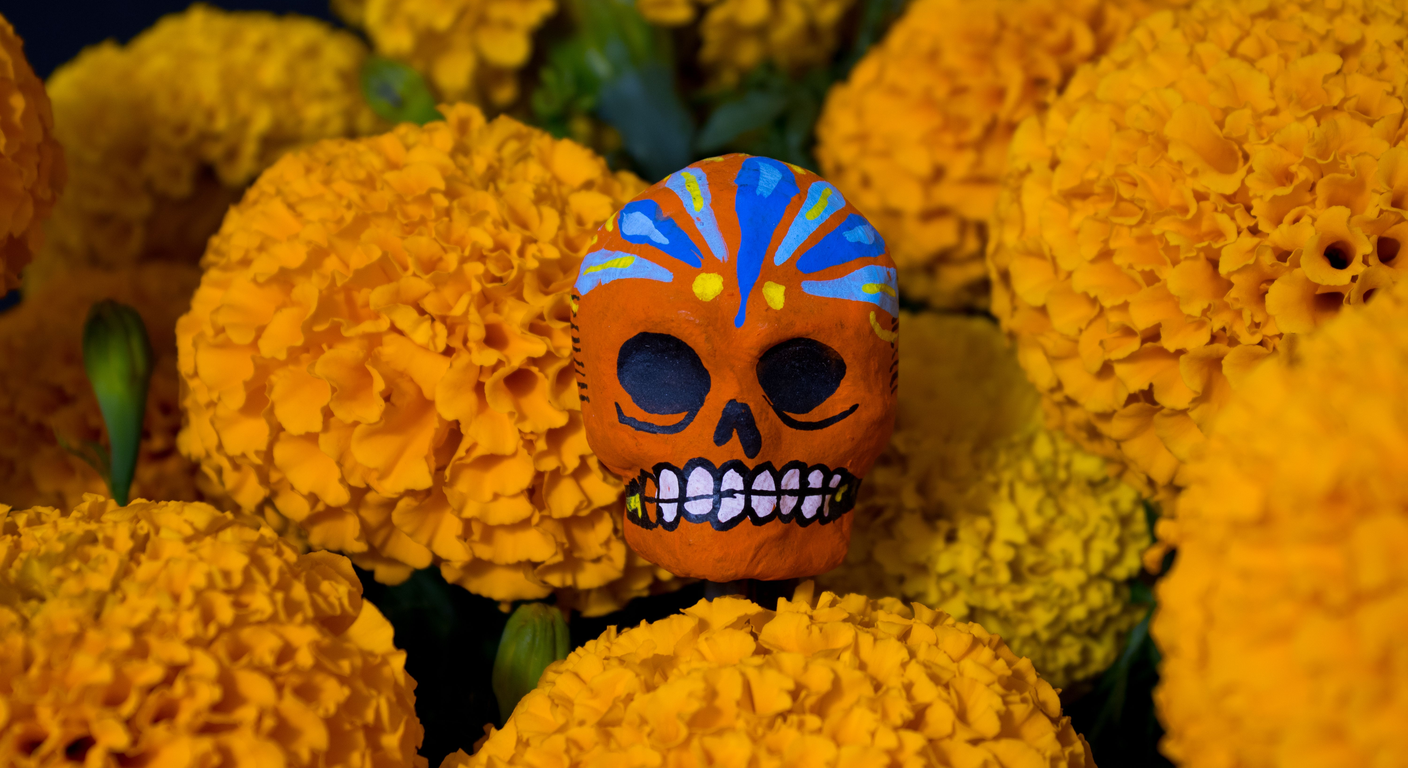
Marigolds (cempasúchil in Náhuatl, or flores de cempasúchil in Spanish) are the iconic flower of Día de Muertos. Their bright orange color and strong scent are said to help guide spirits home. They are everywhere in the tradition, and they’re also the easiest thing in the world for a two-year-old to help make.
You’ll need:
- Orange and yellow tissue paper
- Green pipe cleaners (or string)
- Safety scissors (for the older kids)
What to do: Stack 4–6 squares of tissue paper, accordion-fold the stack, twist a pipe cleaner around the middle, then gently fluff the layers up into a flower shape. Even very small hands can do the fluffing step. Older toddlers love the folding part.
Bilingual vocabulary to weave in:
- flor — flower
- anaranjado / amarillo — orange / yellow
- suave — soft
- pétalo — petal
- cempasúchil — marigold (the traditional name)
- huele bonito — it smells nice
A simple script while you work: “Mira la flor anaranjada. Es suave, ¿verdad? Vamos a hacer más pétalos. Una flor para recordar.” — “Look at the orange flower. It’s soft, right? Let’s make more petals. A flower to remember.”
If you have a yard or balcony, real marigolds are even better. Most garden centers still have them in pots through early November, and the scent is part of the experience.
Activity 2: Decorating calaveritas — sugar skulls without the sugar rush
Traditional calaveritas de azúcar are decorated sugar skulls. With small kids, I skip the actual sugar and use either:
- A small plain ceramic skull from a craft store, or
- A white air-dry clay skull you shape together, or
- A skull-shaped cookie if you want to eat the project
Then decorate with non-toxic puffy paint, washable markers, or stick-on rhinestones. Bright colors, flowers, swirls, little dots. The decoration is joyful, not scary — that’s the whole point.
Vocabulary for the decorating session:
- calaverita — little skull
- color — color (plus all the colors your child knows)
- brillante — bright / shiny
- flores — flowers
- puntitos — little dots
- bonito — pretty / nice
A small thing that matters: name the activity what it is. “Estamos decorando una calaverita para el Día de Muertos.” (We’re decorating a little skull for Day of the Dead.) That’s different from “we’re decorating a Halloween skull.” The vocabulary teaches the tradition.
If your toddler asks why skulls — and they will — a gentle answer in either language is enough. “In this tradition, the skull is happy and colorful. It reminds people that the ones we love are still part of our family, even when they’re gone.”
Activity 3: A small altar conversation
You don’t have to build a full ofrenda to introduce the idea. With ages 2–5, what works is a small, low table or shelf where the family places a few meaningful things together. A photo of a great-grandparent. A flower the child made. A favorite food. Something that belonged to someone who has died — even a pet.
The conversation is more important than the structure. Here’s a soft script:
“Aquí ponemos una foto de bisabuelo. Él era el papá de tu abuela. Le gustaba mucho el café, ¿ves la tacita? Lo recordamos hoy.”
“Here we put a photo of great-grandpa. He was your grandma’s dad. He really loved coffee — do you see the little cup? We remember him today.”
Vocabulary to keep handy:
- foto — photo
- recordar — to remember
- familia — family
- abuelo / abuela / bisabuelo / bisabuela — grandpa / grandma / great-grandpa / great-grandma
- le gustaba… — he/she liked…
- pan dulce — sweet bread
- vela — candle (parent-only — toddlers and open flames don’t mix)
- agua — water (traditionally placed for the spirits’ journey)
Two notes from years of doing this with families. First — toddlers handle death conversations better than adults expect. They take their cues from us. If we’re calm and matter-of-fact, they are too. Second — let them ask questions in either language and answer in both. Code-switching is how bilingual kids actually learn.
If your family hasn’t experienced a recent loss, this conversation can simply be about a great-grandparent the child never met, a beloved pet, or even a public figure your family admired. The point is the practice of remembering, not a particular grief.
A word on what we don’t do
I’ll say this plainly because I get asked: I don’t recommend dressing children in elaborate Catrina costumes, or painting their faces, or mixing Día de Muertos decor with ghosts or witches. Those choices come from years of listening to Mexican educators talk about what feels respectful versus what feels like a costume. Your family will land where it lands — but if you’re not sure, smaller and quieter is almost always the safer call.
The flowers, the colors, the photos, the conversation. That’s plenty for ages 2–5. That’s plenty for most of us, honestly.
How this fits into a bilingual week
If your family is working on Spanish across the year, Día de Muertos vocabulary slots beautifully into a broader theme of family, memory, and emotions. Our 12-month bilingual curriculum builds vocabulary in spirals like this — family words show up in fall, then come back at Mother’s Day, then again when a new sibling arrives. That’s how the words stick.
If you’d like a small free starting point, our printable freebie includes a vocabulary card set you can use this week.
The activities above take maybe 90 minutes total spread across a few afternoons. The conversations will keep going for years. That’s the part that matters.
— Lindsey