How to Use Mealtime to Teach Your Toddler Spanish (No Prep Required)
By Lindsey Carleton, MA, CCC-SLP
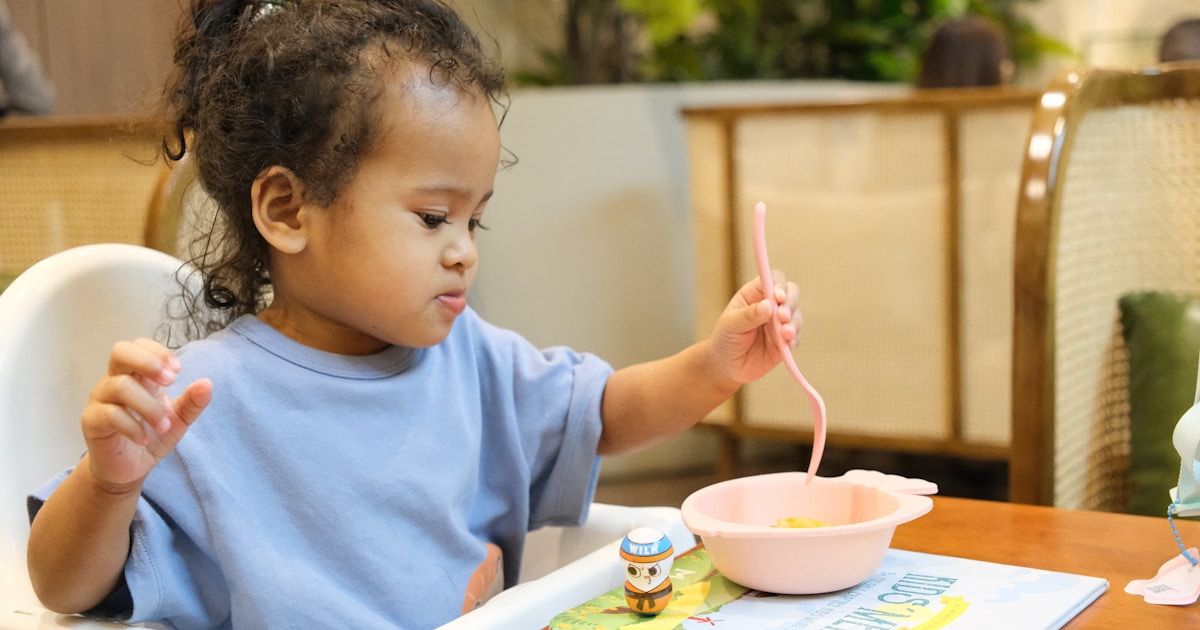
Mealtime is the single best opportunity for bilingual learning in your entire day, and most parents don’t realize it. Think about what mealtimes naturally involve: naming foods, making choices, requesting more, describing tastes, counting pieces, identifying colors. Every one of those interactions is a vocabulary lesson waiting to happen — in Spanish.
Better yet, toddlers are highly motivated during meals. They want the food. They have opinions about the food. They will communicate about the food whether you ask them to or not. That motivation is the fuel that drives vocabulary acquisition. A child who couldn’t care less about a flashcard will absolutely learn the word “galleta” if it means getting a cracker.
This guide gives you the exact phrases to use at breakfast, lunch, dinner, and snack time. No preparation. No materials. Just words layered onto what you’re already doing.
Before the Meal: Setting the Table
The meal starts before the food hits the table, and so does the Spanish. Involve your toddler in setting up and narrate the process:
“Es hora de comer!” (It’s time to eat!) — this becomes the daily signal that switches the language to Spanish. After a few weeks, your toddler will hear this phrase and mentally shift into mealtime mode.
“Necesitamos platos” (We need plates). Hand them a plate. “Pon el plato en la mesa” (Put the plate on the table). “Necesitamos cucharas” (We need spoons). “Y vasos para el agua” (And cups for the water).
This is functional language — Spanish words tied to physical actions your child is performing. They’re touching the plate when they hear “plato,” carrying the spoon when they hear “cuchara.” The multi-sensory connection makes vocabulary stick far more effectively than hearing words in isolation.
Offering Choices (The Either/Or Technique)
This is the most powerful mealtime strategy for bilingual learning, and you can use it at every single meal. Hold up two options and ask your toddler to choose in Spanish:
“Quieres leche o agua?” (Do you want milk or water?) — hold up both.
“Quieres manzana o platano?” (Do you want apple or banana?) — show both.
“Quieres mas pan o mas queso?” (Do you want more bread or more cheese?)
This works for three reasons. First, your toddler is motivated to respond because they want the food. Second, the visual cue (you holding up the item) provides context that makes the Spanish word comprehensible even before they know it. Third, the forced choice means they’re processing two vocabulary words simultaneously and making a decision between them, which requires deeper cognitive engagement than simply hearing a label.
Most toddlers will start by pointing. That’s fine — it shows comprehension. Over time, they’ll begin saying the Spanish word for the item they want. The first time they say “agua” instead of pointing at the water will be a milestone moment. For more on this either/or approach and other daily phrases, see our guide to simple Spanish phrases for toddlers.
During the Meal: Narrating and Labeling
Once the food is served, become a Spanish narrator. Describe what’s on the plate, what it looks like, what it tastes like. Keep it simple and repetitive:
Labeling foods: “Esto es pollo” (This is chicken). “Aqui hay arroz” (Here’s rice). “Y tenemos brocoli” (And we have broccoli). Point to each item as you name it. Do this every time you serve these foods — the repetition is what builds recognition.
Describing with colors: “La zanahoria es anaranjada” (The carrot is orange). “Los frijoles son negros” (The beans are black). “Tu leche es blanca” (Your milk is white). This doubles your vocabulary input — they’re learning food words and color words in the same sentence.
Taste words: “Mmm, que rico!” (Mmm, how yummy!). “Esta caliente, cuidado” (It’s hot, careful). “Esta frio” (It’s cold). “Es dulce” (It’s sweet). “Es salado” (It’s salty). Taste adjectives connect to immediate sensory experience, which creates strong memory anchors.
Action words: “Come tu pollo” (Eat your chicken). “Toma tu agua” (Drink your water). “Mezcla el arroz” (Mix the rice). “Sopla, esta caliente” (Blow, it’s hot). Verbs learned during meals transfer easily to other contexts because eating actions are universal.
The Magic Phrases (Use These Every Meal)
These 10 phrases cover 90% of what happens during a toddler meal. Use them at every meal until they’re automatic for both you and your child:
1. “Es hora de comer” (It’s time to eat)
2. “Sientate, por favor” (Sit down, please)
3. “Que quieres?” (What do you want?)
4. “Quieres mas?” (Do you want more?)
5. “Mas, por favor” (More, please) — model this so they learn to request politely
6. “Que rico!” (How yummy!)
7. “Todo listo?” (All done?)
8. “Limpia tus manos” (Clean your hands)
9. “Buen provecho” (Enjoy your meal — the Spanish equivalent of bon appetit)
10. “Gracias por comer” (Thanks for eating)
Print these out and tape them to the fridge or inside a kitchen cabinet. Within two weeks, you won’t need the list anymore. Within a month, your toddler will recognize all 10 and probably use 3-4 of them unprompted.
Breakfast Spanish (La Hora del Desayuno)
Breakfast tends to be the most routine meal — same foods, same sequence, same rush. That predictability is perfect for bilingual learning because repetition is built in automatically.
Breakfast vocabulary to rotate: Cereal (cereal), huevos (eggs), pan tostado (toast), leche (milk), jugo (juice), yogur (yogurt), fruta (fruit), platano (banana), fresas (strawberries), avena (oatmeal).
A typical breakfast narration: “Buenos dias! Es hora de desayunar. Quieres huevos o cereal?” (Good morning! Time for breakfast. Do you want eggs or cereal?). “Aqui estan tus huevos. Y un poco de fruta — mira, fresas rojas” (Here are your eggs. And some fruit — look, red strawberries). “Quieres jugo o leche?” (Do you want juice or milk?).
That entire exchange introduces 6-8 Spanish words in under a minute. Repeat it tomorrow with slightly different foods and the vocabulary base grows automatically.
Lunch and Dinner Spanish (Almuerzo y Cena)
Lunch and dinner offer broader vocabulary because the foods are more varied. Use the same framework — label, describe, offer choices — with expanded vocabulary:
Lunch/dinner vocabulary: Pollo (chicken), carne (meat), pescado (fish), arroz (rice), frijoles (beans), pasta (pasta), sopa (soup), ensalada (salad), pan (bread), queso (cheese), verduras (vegetables), papa/patata (potato), tomate (tomato), maiz (corn).
Utensil vocabulary: Cuchara (spoon), tenedor (fork), cuchillo (knife — for you, not the toddler), plato (plate), vaso (cup/glass), servilleta (napkin).
As your child gets older (3+), expand to full sentence interactions: “Que comiste hoy?” (What did you eat today? — great for after daycare/preschool). “Cual es tu comida favorita?” (What’s your favorite food?). “Puedes pasar la sal?” (Can you pass the salt?).
Snack Time Spanish (La Merienda)
Snacks are actually your most flexible mealtime teaching moment because there’s less pressure. Nobody’s worried about nutrition or finishing plates. It’s relaxed, and relaxed learning is effective learning.
Snack vocabulary: Galleta (cracker/cookie), manzana (apple), uvas (grapes), zanahoria (carrot), queso (cheese), yogur (yogurt), palomitas (popcorn), helado (ice cream — for special occasions).
Use snack time to practice counting: “Cuantas galletas quieres? Una, dos, tres?” (How many crackers do you want? One, two, three?). Count grapes onto the plate: “Uno, dos, tres, cuatro, cinco uvas” (One, two, three, four, five grapes). Counting with food combines number vocabulary with the motivation of getting to eat what you’re counting.
Cooking Together in Spanish
If your toddler likes being in the kitchen (and most do), cooking together opens up a vocabulary world beyond what eating alone provides. Even simple tasks like stirring, pouring, and washing give you action verbs that transfer to other activities:
“Vamos a cocinar!” (Let’s cook!). “Mezcla, mezcla, mezcla” (Mix, mix, mix — while stirring). “Pon la harina aqui” (Put the flour here). “Agrega el agua” (Add the water). “Huele delicioso!” (It smells delicious!). “Esta listo!” (It’s ready!).
Baking is especially good because the sequence is predictable and repeatable. Every time you make pancakes together, the same Spanish vocabulary appears in the same order. By the fifth time you make pancakes, your toddler knows “mezcla,” “huevo,” “leche,” and “listo” without ever having studied them.
Making It Stick Long-Term
The beauty of mealtime Spanish is that it never runs out. You eat every day, forever. The vocabulary evolves as your child grows — from basic food labels at age 2 to meal planning conversations at age 5 — but the routine stays constant. That built-in consistency is what makes mealtime the most sustainable bilingual habit you can build.
Start with the 10 magic phrases this week. Use them at one meal per day. After two weeks, you’ll feel comfortable enough to expand to all three meals. After a month, mealtime Spanish will feel as natural as saying “please” and “thank you.”
If you want a complete bilingual system that extends beyond mealtimes — covering play, bath time, outdoor activities, and bedtime with the same scripted approach — the Palabra Garden 12-Month Bilingual Curriculum provides weekly themed activities with weekly lesson plans and parent guides.
Ready to get started? Download the free bilingual starter kit for printable phrase guides you can stick on the fridge tonight.