Spanish Fire Safety and 911 for Toddlers
By Lindsey Carleton, MA, CCC-SLP
Teach kids 911 Spanish before they “need” it, because by the time they need it, it’s too late to start. The good news: a 4-year-old can learn the core emergency phrases in about three weeks of casual, low-stress practice. The bad news: most bilingual curricula skip this entirely.
This is one of the most important vocabulary sets we cover, and it’s the reason we built the emergency preparedness and community safety bundle.
The non-negotiable 5 phrases
If you teach nothing else, teach these:
| Spanish | English |
|---|---|
| Llama al 911 | Call 911 |
| Hay fuego | There’s a fire |
| Ayuda | Help |
| Me llamo… | My name is… |
| Mi mamá / mi papá se cayó | My mom/dad fell |
Why bilingual matters here
In a real emergency, your child may be the one talking to a Spanish-speaking neighbor, a 911 operator who connects them with a Spanish interpreter, or a Spanish-speaking grandparent. The seconds saved by your child knowing fuego alongside fire can matter.
The Spanish emergency vocabulary list
Fire safety (10 words)
| Spanish | English |
|---|---|
| fuego | fire |
| humo | smoke |
| caliente | hot |
| quemar | to burn |
| bombero | firefighter |
| camión de bomberos | fire truck |
| alarma | alarm |
| salir | to go out / exit |
| correr | to run |
| seguro | safe |
911 / Emergency (8 words)
| Spanish | English |
|---|---|
| 911 (nueve uno uno) | 911 |
| emergencia | emergency |
| ayuda | help |
| llamar | to call |
| policía | police |
| ambulancia | ambulance |
| hospital | hospital |
| doctor | doctor |
Personal info (your child should know in both languages)
- Their full name — Me llamo ____.
- Their age — Tengo ___ años.
- Their parents’ first names — Mi mamá se llama ____.
- Their home address — Vivo en ____.
- A phone number — El número de teléfono es ____.
A 4-week emergency learning plan
Keep this light. The point is familiarity, not fear.
Week 1: What an emergency is
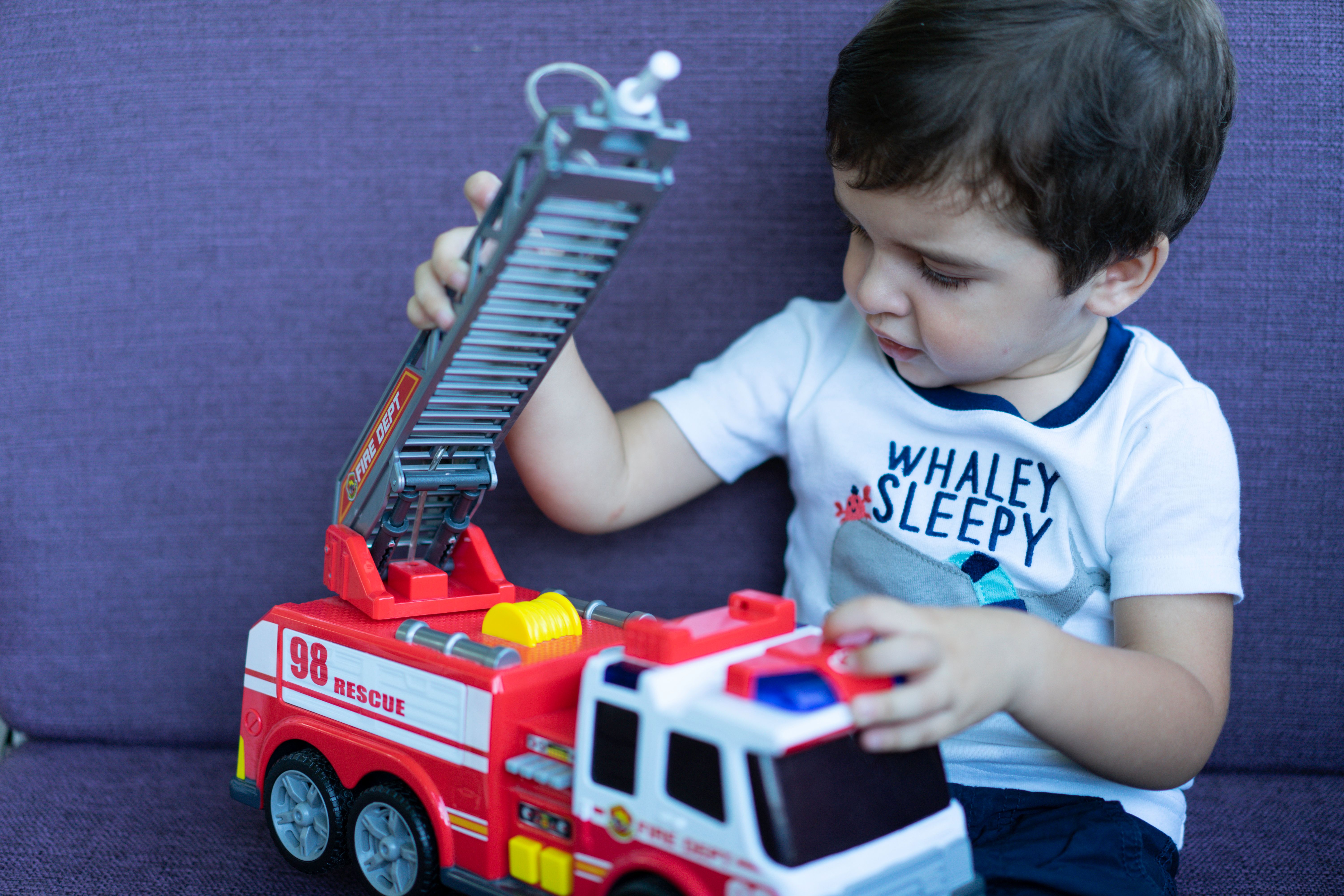
Start with the concept, not the panic. Read a picture book about a fire truck or firefighters — your library will have bilingual options. Introduce bombero, camión de bomberos, fuego, alarma.
Week 2: What 911 is
Teach the phrase “Llama al 911.” Don’t let them play with a real phone — use a toy phone. Practice saying “nueve uno uno.” Add emergencia, ayuda, policía.
Week 3: Personal info
Practice their full name, age, and parents’ names in both languages. Make it a song if it helps. Add address and phone number for older toddlers.
Week 4: The whole script
Run a pretend scenario: “Pretend the alarm goes off. What do we do?” Walk through it. Salir. Correr. Seguro afuera. No fear, just rehearsal.
Want this whole topic done as a structured bundle? Our emergency preparedness and community safety bundle is $25 and gives you the cards, parent guides, and activities for safety vocabulary that most curricula leave out.
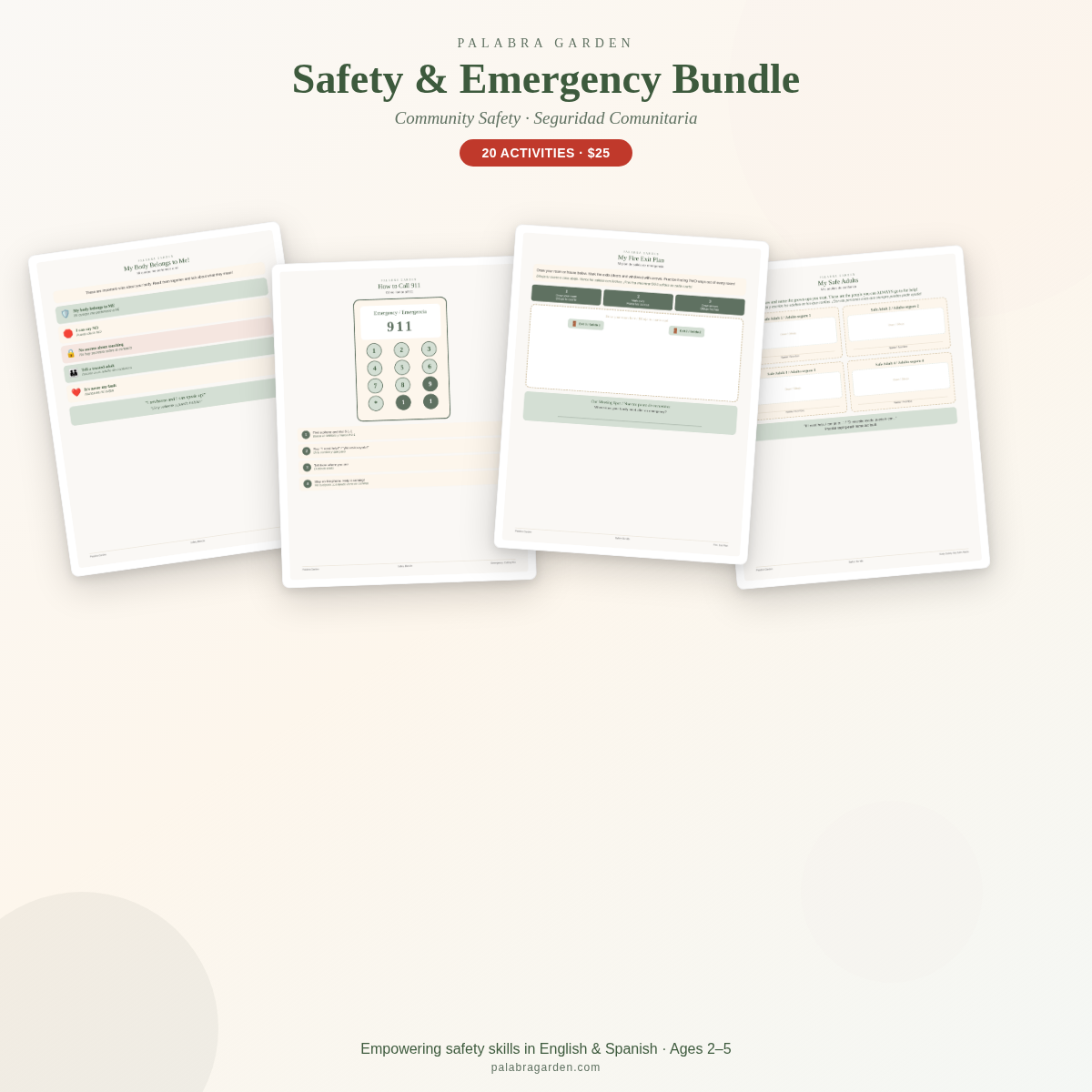
The script for “what to do in a fire”
Drill this casually, like a song:
- La alarma suena. (The alarm sounds.)
- Salimos. (We go out.)
- No regresamos. (We don’t go back.)
- Vamos al lugar seguro. (We go to the safe place.)
- Llamamos al 911. (We call 911.)
Pick a “safe place” outside your house — the mailbox, the neighbor’s tree, the end of the driveway. Practice walking there a few times throughout the year.
The 911 script
If you teach your child to call 911 (most experts recommend this around age 4), the script is short:
- “Hay una emergencia.”
- “Me llamo ____.”
- “Vivo en ____.” (address)
Most 911 systems have Spanish interpreters available. Your child saying “ayuda” or “emergencia” still triggers help even if they can’t say the address.
What NOT to do
- Don’t make it scary. Toddlers process fear differently than adults. Calm voice, matter-of-fact tone.
- Don’t drill in the middle of the night. Daytime, low-stress.
- Don’t use real 911 to practice. Use a toy phone or unplugged old phone.
- Don’t quiz under pressure. “What’s the number?!” creates anxiety, not learning.
- Don’t skip personal info because it feels morbid. It saves lives.
Pair with a plan for getting lost or separated
If your child is around 4–5, this is a natural age to talk through a simple family plan together: what to do if you ever get separated in a store, at a park, or in a crowd. What that plan should be is worth getting right — so rather than a one-size-fits-all rule, we’ll point you to the child-safety experts. The free KidSmartz program from the National Center for Missing & Exploited Children walks families through age-appropriate, up-to-date guidance you can build your plan on.
Once you’ve made your plan, you can rehearse the key words in Spanish too — perdido (lost), espera (wait), ayuda (help).
Other safety vocabulary that earns its place
A few extra words worth teaching:
- Peligro — danger
- Quédate aquí — stay here
- Espera — wait
- No toques — don’t touch
- Mira en los dos lados — look both ways (street crossing)
Practice with the 12-month curriculum
The full curriculum has a community-and-safety block where this vocabulary is taught alongside other community helper words (doctor, nurse, mail carrier, etc.). If you’re using the curriculum, this block usually lands in the spring.
Real-life moments to use these words
You don’t need an actual emergency to practice. Use everyday moments:
- A fire truck drives by: “Mira, el camión de bomberos!”
- A smoke alarm beeps: “Esa es la alarma. Salimos cuando suena.”
- They burn their finger on something warm: “Caliente! Cuidado.”
- They watch a doctor visit on TV: “La doctora ayuda a la gente.”
That’s the entire bilingual safety curriculum, woven into normal life.
What ages can learn what
| Age | Realistic target |
|---|---|
| 2 | Recognize bombero, fuego, ayuda |
| 3 | Say ayuda, point to fire truck |
| 4 | Say full name and “llama al 911” |
| 5 | Recite address and parents’ names |
Don’t push the older targets onto a younger child. By age 5, most kids can manage the full script.
A free starter
The Palabra Garden freebie includes a starter safety card you can use today, before deciding on the full bundle.
Frequently asked questions
At what age should I teach 911?
Around age 3–4. Recognition of “ayuda” and the concept of asking for help can start at 3. Actually calling 911 (using a real phone in a real emergency) requires the maturity to dial — most kids are ready by 4 or 5.
Will teaching emergency vocabulary scare my child?
Not if you keep it calm and matter-of-fact. Children handle this surprisingly well when adults are calm. Practicing fire drills the way you practice brushing teeth — routine, not dramatic — works best.
Does 911 actually have Spanish operators?
Most 911 centers in the U.S. have access to interpreters within seconds. Your child saying emergencia triggers the language ID even if the rest of the conversation needs interpretation.
What if we live in a Spanish-only home and child only speaks Spanish?
Teach both anyway. In an emergency the first responder may be English-only. The 30 seconds to switch languages can matter.
Should I include 911 practice in our weekly plan?
Once a month is plenty for review. Initial learning is the 4-week plan above; after that, revisit every 4–6 weeks. Over-drilling can create anxiety.
What about earthquake / hurricane / other regional emergencies?
Adapt by region. Terremoto (earthquake), huracán (hurricane), tornado (tornado), inundación (flood). Teach what your region actually faces, not every theoretical disaster.