Reading Aloud in Spanish When You're Not Fluent
By Lindsey Carleton, MA, CCC-SLP
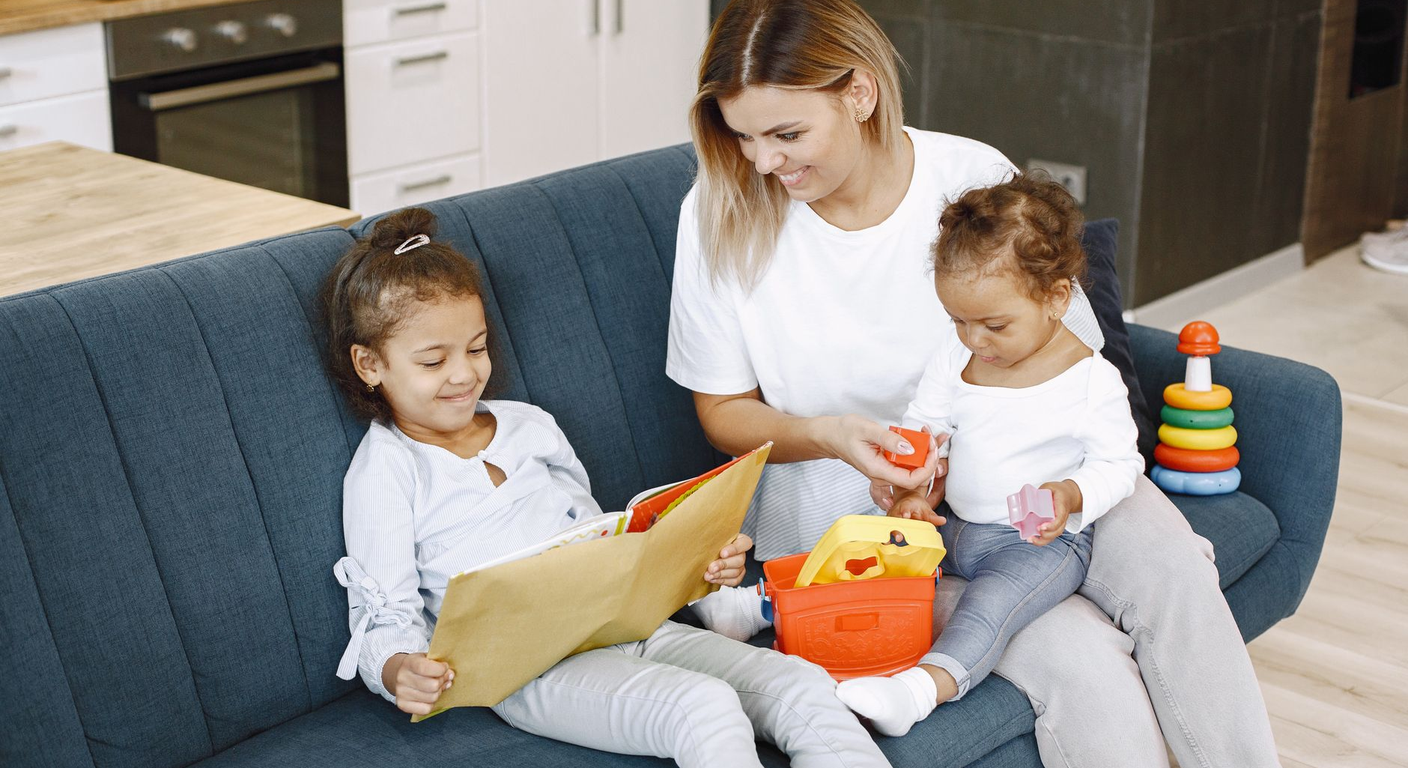
The Spanish picture book has been on the shelf for four months. You bought it with real intentions. You have not read it, because the first time you tried, you got three pages in, hit a word you didn’t know, guessed at it, and felt like a fraud in front of a two-year-old who could not have cared less.
I know this because it’s the single most common thing parents confess to me about books. Not “we don’t have any” — “we have them and I avoid them.”
So let’s deal with the actual obstacle, which is not your Spanish. It’s the belief that reading aloud is a performance that can be failed.
What the research actually values — and what it doesn’t
Reading aloud with young children is about as well-supported as parenting advice gets. The American Academy of Pediatrics recommends shared reading beginning at birth and continuing through at least kindergarten, and links it to broader vocabulary and stronger language skills at school entry (AAP policy statement, Literacy Promotion: An Essential Component of Primary Care Pediatric Practice, 2024).
Read the reasoning closely, though, because it matters for you specifically. The benefit is attributed to shared reading — the interaction, the back-and-forth, the warmth, the language that happens around the book. Not to fluent oral performance of the text.
Nobody has ever demonstrated that a child needs their parent to read with a perfect accent. What children need is an adult, a book, and talk. You can supply all three today.
The thing I most want you to hear
Your toddler is not evaluating your Spanish. They have no reference point for what “good” Spanish sounds like, and they will not acquire your accent as a permanent ceiling — they’ll hear native speakers in songs, in media, from family, at school, and their system will keep updating.
What they are reading, constantly and accurately, is whether this activity feels good. A parent who is tense, apologetic and self-correcting teaches a toddler that Spanish is a thing adults get nervous about. A parent who plows cheerfully through a book getting things wrong teaches them Spanish is something you can just do.
That second lesson is worth more than the pronunciation.
Four techniques that do the heavy lifting
Here’s the part that changes the outcome. None of these require more Spanish than you already have.
1. Look it up once, before bed. Not during. Pick the book you’ll read tonight, skim it in advance, and look up the two or three words you don’t know. Two minutes. The anxiety you feel mid-page is almost entirely about being caught off guard, and this removes that. Forvo gives you native speakers saying individual words, free.
2. Don’t read every word. Talk about the page. This is the single biggest shift, and it’s what good preschool teachers do instinctively. Instead of decoding the full sentence, name what’s there. “Mira — el perro. El perro está durmiendo. ¿Dónde está el gato?” (Look — the dog. The dog is sleeping. Where’s the cat?) You’ve just produced more usable toddler language than the paragraph would have, in words you’re sure of.
This has a name in my field — dialogic reading — and the evidence behind it is the reason I’d rather you talk about three pages than perform twelve.
3. Reread the same book absurdly often. Adults find this unbearable and toddlers find it essential. Repetition is how vocabulary moves from “heard once” to “available.” It also means your own fluency with that specific book climbs fast — by the fifth night you’re not decoding, you’re reading, and your child hears the difference.
4. Let them finish the line. Once a book is familiar, stop just before the predictable word and wait. “El sol está…” (The sun is…) Pause. Give it a full five seconds, which will feel much longer than it is. This moves them from listening to producing, and it’s the closest thing to free language practice that exists.
What to do when you hit a word you can’t say
Say something, keep going, and circle back later if you care. A guessed pronunciation inside a warm, continuing story does less damage than stopping the story.
What I’d avoid is the apology. “Sorry, mami’s Spanish is bad” teaches a lesson you don’t want taught, and your toddler had no complaint until you raised one.
If pronunciation genuinely nags at you, handle it outside the moment. The Pronunciation Companion that ships with the 12-month curriculum walks through the five sounds English speakers stumble on most, and free tools like Forvo cover one-off words.
Choosing books that make this easier
Not all Spanish picture books are equally kind to a non-fluent reader.
- Short, repetitive text beats beautiful prose. A book with the same sentence frame on every page gives you one structure to master instead of twelve.
- Rhyme is harder than it looks. Rhyming text in a second language is genuinely difficult to read aloud with rhythm. Skip it early on.
- Board books with one object per page are nearly cheat mode — you’re naming, not reading, and naming is where toddler vocabulary lives anyway.
- Books you already know in English remove the comprehension load entirely. You know what happens, so your attention is free for the language.
- Dual-language editions let you handle a hard page in English and come back to the Spanish, without it feeling like defeat.
The honest bottom line
A parent reading imperfect Spanish for six minutes a night, most nights, for a year, produces a child with meaningfully more Spanish than a parent who read nothing while waiting to get better.
That’s the whole comparison. It isn’t you against a native speaker. It’s you against the book staying on the shelf.
Start tonight with the one you already own. Three pages is a real thing. Your accent is fine.