Making a Toddler-Friendly Ofrenda — A Step-by-Step Bilingual Project
By Lindsey Carleton, MA, CCC-SLP
Before the how-to, a one-paragraph disclaimer that the rest of the piece depends on: I’m not Mexican. I’m a speech-language pathologist who learned Spanish in college and through clinical work, and I’m writing this as someone outside the tradition for other families also outside the tradition. The ofrenda is a Mexican cultural practice with deep meaning, and the version I’m describing below is a small, family-level adoption — not a performance of Mexican tradition. If you haven’t read our Día de los Muertos primer yet, start there; this piece assumes you have.
That said. If you and your toddler are going to spend an hour together this week building a small altar to remember the people your family has loved and lost, it can be a genuinely meaningful project — for the kid, for you, and for the Spanish vocabulary you’ll repeat across the week. Here’s how to do it.
What an ofrenda is, in one sentence for a four-year-old
“An ofrenda is a special little table where we put pictures and flowers and food to remember the people in our family who aren’t here anymore.”
That’s the script. Say it once on the morning you start. Don’t lecture. Toddlers absorb meaning from the activity, not from explanations.
The elements — and what each one means
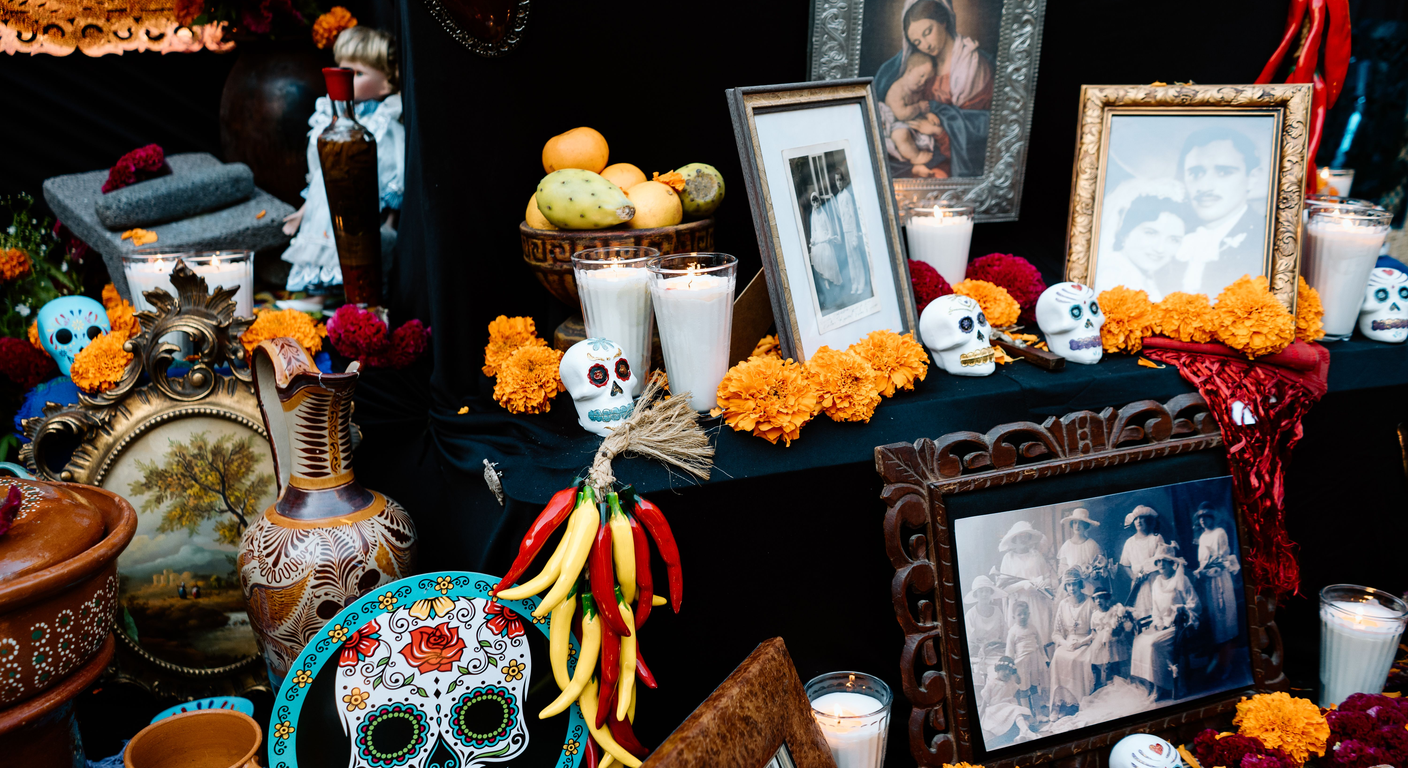
Traditional Mexican ofrendas have several specific elements, each with its own meaning. A toddler-friendly version is a simplified subset. Here are the core elements, what each represents, and the Spanish vocabulary that goes with it.
La foto — the photo. Photos of the deceased family members you want to remember. This is the anchor of the whole altar. Print real photos if you can; toddlers respond to a physical photo on a table differently than to a screen.
La vela — the candle. Candles light the way for the spirits to find their way home. For a toddler-friendly version, use a battery-operated tea light. There is zero benefit to having an open flame on a low table near a two-year-old.
La flor de cempasúchil — the marigold. The bright orange-and-yellow marigold is the traditional flower of Día de los Muertos. Its scent is said to guide spirits. Real marigolds are widely available at grocery stores in late October; if you can’t find them, paper marigolds made with your toddler are a beautiful substitute and also a craft.
El agua — the water. A small glass of water for the spirits, who have traveled far and are thirsty. A toddler understands this immediately.
La comida — the food. A favorite food of the deceased person. Bread, fruit, a piece of candy. Anything they loved.
El pan de muerto — the bread of the dead. A specific sweet bread baked for the occasion. Available in many Mexican bakeries and grocery stores in late October. If you don’t have access, any sweet bread works as a stand-in for a non-Mexican family’s version.
La sal — the salt. Salt represents the continuity of life. A small dish.
Algo personal — something personal. A favorite toy, a favorite book, a piece of jewelry, a tool — anything that belonged to or evokes the person being remembered.
You don’t need all of these. Three is enough. Photo, flower, candle. That’s a complete small ofrenda for a toddler-led project.
The step-by-step
This is a two-day project, roughly. Day one is gathering. Day two is building. You can compress it into one afternoon if you have everything already, but spreading it across two days gives your toddler time to think about it.
Day one — choose and gather
Step 1: Choose the spot. Pick a small surface in a low-traffic part of your home. A side table, a shelf at toddler height (so they can see it without climbing), a corner of a credenza. Avoid the dining table — you want this to be its own thing, not in competition with dinner.
Phrase to say: “Vamos a hacer una ofrenda aquí. Es un lugar especial.” (“We’re going to make an ofrenda here. It’s a special place.”)
Step 2: Choose the photos. Sit down with your child and look through a few framed photos or printed pictures of family members who have died. Talk about each one briefly. “Esta es la abuela de Mami. Era muy graciosa.” (“This is Mom’s grandma. She was very funny.”)
If your family hasn’t lost a close relative recently, you can include great-grandparents, pets, or even a family friend the child knew. This is your family’s ofrenda. There’s no rule about who counts.
Step 3: Gather the other elements. A walk to the grocery store for marigolds. A stop at a Mexican bakery for pan de muerto if you have one nearby. A battery tea light from the dollar store. A small dish for salt, a small glass for water. A favorite toy if there’s a child in your family who has died.
For toddlers, the gathering walk is half the project. Narrate everywhere:
- “Vamos a comprar flores.” (“We’re going to buy flowers.”)
- “Necesitamos una vela pequeña.” (“We need a small candle.”)
- “El pan de muerto es para la ofrenda.” (“The pan de muerto is for the ofrenda.”)
Day two — build
Step 4: Lay a small cloth. A small cloth, table runner, or scarf in a meaningful color. Many Mexican ofrendas use purple (mourning), white (purity), or bright multicolored cloth. Anything works. Let your toddler smooth it out — they love smoothing things.
Step 5: Place the photos. Center them. Three or four maximum. As you place each one, name the person. “Aquí va la abuela.” (“Here goes grandma.”) Let your toddler hand you each one. They are going to want to rearrange them six times. That’s fine.
Step 6: Add the flowers. Marigolds in a small vase or scattered around the photos. Real or paper. If your toddler made paper marigolds the day before, this is the moment they go on the altar — and it’s the moment most three- and four-year-olds become genuinely invested in the project.
Step 7: Add the candle. Battery tea light, turned on. “La vela les ayuda a encontrar el camino.” (“The candle helps them find the way.”) A four-year-old will get this immediately. A two-year-old will just like the light.
Step 8: Add water, salt, food. A small glass of water, a small dish of salt, and a piece of pan de muerto (or a favorite food of the person being remembered). “Para que tengan algo de comer y beber.” (“So they have something to eat and drink.”)
Step 9: Add something personal. If you have a small object that belonged to the person — a piece of jewelry, a small tool, a book — put it on the altar. If not, a favorite-color rock from your yard works. Toddlers understand symbolic objects intuitively.
Step 10: Sit with it. Spend five minutes sitting in front of the finished ofrenda with your child. Don’t perform. Just sit. Maybe say one thing about one of the people remembered. “Mi abuela hacía las mejores tortillas.” (“My grandma made the best tortillas.”) Toddlers learn how to relate to death from watching the adults around them. Calm, warm, conversational is the right register.
The vocabulary list — ten words for the week
If you teach nothing else from this project, these ten words will repeat through the activity often enough that your toddler will know them by November 3.
- la ofrenda — the offering / altar
- la foto — the photo
- la vela — the candle
- la flor — the flower
- la flor de cempasúchil — the marigold
- el agua — the water
- la comida — the food
- el pan de muerto — the bread of the dead
- recordar — to remember
- la familia — the family
Use them in real sentences during the building. “Pásame la vela, por favor.” “Vamos a poner la foto aquí.” “Recordamos a la abuela.” Said ten or fifteen times across the project, these will stick.
What to do with the ofrenda after
A traditional Mexican ofrenda stays up through November 1 and 2, and is taken down on November 3. The food on the altar is then often eaten — the idea being that the spirits have taken the essence and left the substance for the living.
For a toddler family, I’d follow the same rhythm. Take a photo of the finished ofrenda on the morning of November 2. Sit with your child once more that evening. Take it down the morning of November 3 together. “Ya pasaron los días. Vamos a guardar las cosas.” (“The days have passed. Let’s put the things away.”) Save one marigold pressed in a book for next year.
The deeper thing this teaches a toddler
I want to flag something that surprises a lot of parents the first time they do this. Building a small ofrenda with a two- or three-year-old gives that child their first real, calm experience of death as part of life. The American default — protect children from death entirely, talk about it only when forced to — does not actually make kids more comfortable with it. The opposite. Kids whose families have a yearly, warm, low-stakes ritual of remembering their dead grow up with much less anxiety about loss.
This is one of the gifts Mexican culture offers to a wider conversation. It’s a gift worth accepting with both hands, and worth crediting.
If you’d like more bilingual, culturally grounded weekly activities like this one planned out across the year, the 12-month bilingual curriculum is the rhythm I built for exactly that. A free week is at the freebie page.
— Lindsey