Teaching Your Toddler Spanish at the Grocery Store
By Lindsey Carleton, MA, CCC-SLP
Produce Section: Colors, Shapes, and Basic Food Words (15 Words)
The produce section is visual chaos in the best way possible for a toddler learning colors. Red apples, yellow bananas, orange carrots, green lettuce. Everything is labeled, everything is colorful, and everything is immediately learnable.
Fruits and Vegetables: Start with the ones your child actually eats or sees at home. “La manzana roja” (the red apple). “El platano amarillo” (the yellow banana). “Las zanahorias anaranjadas” (the orange carrots). “Las uvas moradas” (the purple grapes).
Your child doesn’t just hear the word. They see it, touch it, maybe smell it. That multi-sensory input makes the vocabulary stick.
Colors: This is the best place to teach colors in Spanish because there are so many vivid examples. Pick up an apple: “Rojo” (Red). Point to lettuce: “Verde” (Green). Touch a banana: “Amarillo” (Yellow).
Quantities: Point to bunches of grapes: “Muchas uvas” (Many grapes). One carrot: “Una zanahoria” (One carrot). This is real math vocabulary emerging from actual context.
Touch and describe: Let your child touch produce (the bumpy texture of an orange, the smooth skin of an apple) and describe: “Liso” (smooth) or “Aspero” (bumpy).
Dairy Section: Cold, Count, and Compare (10 Words)
Milk, yogurt, cheese, butter: “La leche fria” (the cold milk). “El queso” (the cheese). “La mantequilla” (the butter).
Let your child touch the glass doors and say “Frio” (cold). Kids love feeling the cold air. Combine the vocabulary with sensation.
Counting yogurts: Pick up the yogurt multi-packs. “Uno, dos, tres yogures” (One, two, three yogurts). You’re teaching numbers in context. Your child sees three yogurts and hears the number three said in Spanish.
Size comparisons: “Este queso es grande” (This cheese is big). “Este queso es pequeno” (This cheese is small). You’ve layered in adjectives, comparative language, and food vocabulary all at once.
Bakery Section: Bread, Pastries, and Smell (8 Words)
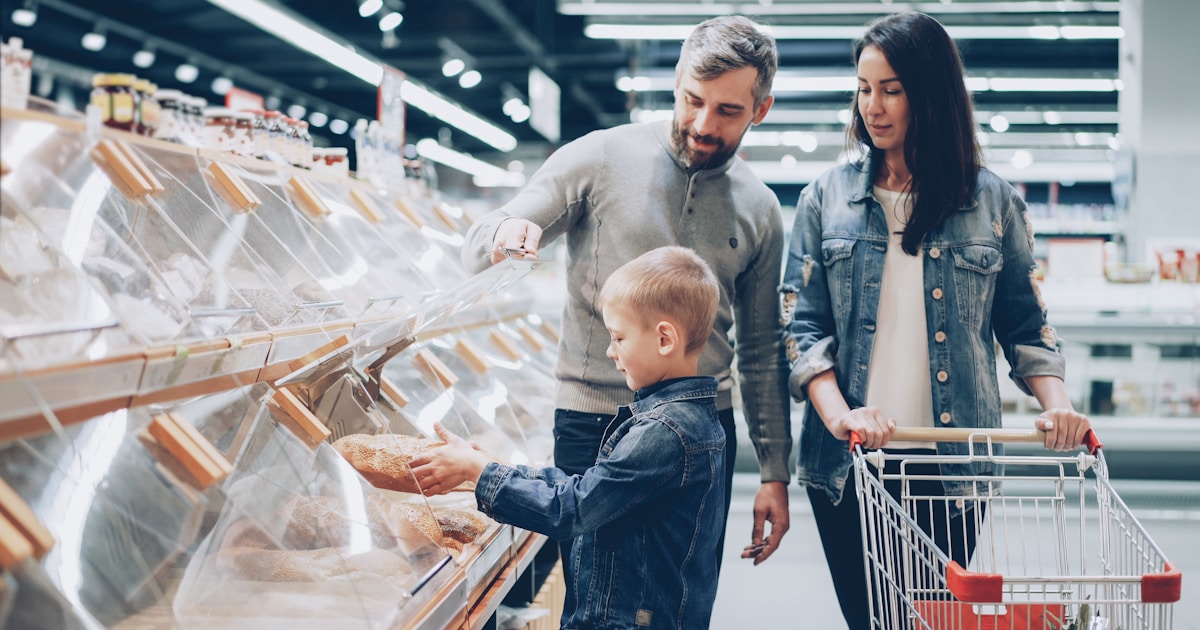
This is the sensory powerhouse of the grocery store. Warm smells, beautiful displays, and foods that toddlers actually get excited about.
Pan and pastries: “El pan” (bread). “Las galletas” (cookies). “El pastel” (cake). “Los donuts” (donuts). If your child asks for something from the bakery, you have your vocabulary lesson ready-made.
How things smell and look: “Que rico! Huele delicioso” (How yummy! It smells delicious). “Es cafe” (It’s brown). “Esta calientito” (It’s warm).
What would you eat? “Te gusta el pan?” (Do you like bread?) “Quieres galletas?” (Do you want cookies?) Your child is hearing questions in Spanish and learning to answer (or at least express preferences).
Meat and Protein Section: Words and Safety (6 Words)
Depending on your family’s diet, this section has vocabulary for proteins. Keep it simple and pair it with context.
Basic foods: “El pollo” (chicken). “La carne” (meat). “El pescado” (fish). “Los huevos” (eggs).
Safety language: “Frio, tenemos que ser cuidadosos” (Cold, we have to be careful). “La carne esta cruda” (The meat is raw). Teaching safety vocabulary in context is smart parenting and smart language teaching.
Checkout and Bagging: Numbers and Action Words (5 Words)
The checkout line is often where toddlers get bored or fussy. Turn it into a language opportunity.
Count the items on the conveyor: “Uno… dos… tres… cuatro…” Point to each item as you count. Your child hears Spanish numbers in a context where they’re actively watching items move.
Name the items as they go: “Aqui va la leche” (Here goes the milk). “Ahora las frutas” (Now the fruits). “Voy a poner el pan” (I’m going to put the bread in the bag).
Ask your child to help: “Puede poner la manzana en la bolsa?” (Can you put the apple in the bag?) Toddlers love having a job. They’re hearing Spanish, executing instructions, and feeling capable.
Celebrate at the end: “Listo! Terminamos!” (Done! We finished!) Positive closing makes the whole outing feel successful.
Making a Spanish Shopping List with Your Toddler
This is a preparation activity that makes the actual shopping trip even richer.
The day or morning before you go grocery shopping, sit with your toddler and a piece of paper. Ask them: “Que necesitamos?” (What do we need?) Then, as they answer or you suggest items, draw simple pictures and write the Spanish words.
Your child draws an apple and you write “manzana.” Your child points to a picture of milk and you write “leche.” You’re building vocabulary and pre-teaching the words you’ll hear at the store.
Then at the store, you have the list. “Necesitamos la manzana. Vamos a buscar las manzanas.” You’re not teaching new vocabulary; you’re reinforcing what you already introduced. That repetition is what builds actual language skill.
Even if your child is too young to draw or suggest items, making the list yourself and showing it to them before you go plants the vocabulary ahead of time. Repetition plus context is how toddlers learn fastest.
Why the Grocery Store Works for Bilingual Learning
The grocery store hits every condition for effective language learning with toddlers:
Real context: Your toddler isn’t learning isolated vocabulary words. They’re learning words that connect to actual needs (hunger, cold, preferences). That context sticks.
Multi-sensory input: Sight, touch, smell, taste (if you’re sampling). Visual input plus physical sensation plus language input creates multiple neural pathways for the same word.
Repetition: You go to the grocery store weekly. You see the same sections, the same foods (mostly), the same layout. That repetition is how language builds. You’re not looking for novelty; you’re looking for consistency.
No pressure: You’re not testing your child or asking them to perform. You’re just narrating what you’re doing and what you’re seeing. Language absorption happens without the child feeling like they’re in school.
Natural breaks and transitions: The store naturally moves from section to section. Each section is a new vocabulary set. Your child’s attention naturally refreshes as you move around. You’re not sitting in one place trying to maintain focus; the environment does that for you.
Managing Behavior and Language at the Same Time
Sometimes toddlers get overwhelmed or fussy at the store. That’s not a sign that Spanish learning isn’t working. That’s just… toddler shopping.
If your child is overwhelmed, simplify. Stop teaching vocabulary and just be present. “Todo esta bien. Estamos casi listo” (Everything is okay. We’re almost done). Calm, present Spanish is still teaching language, even if it’s not the fun learning kind.
If your child is asking to leave or getting upset, that’s a sign you should wrap up the trip (or your language teaching portion of it). It’s better to end on a positive note and return next week than to push and create a negative association with Spanish shopping.
You don’t have to teach Spanish the entire time you’re at the store. Even fifteen minutes of focused vocabulary building is a win. You’re stacking a good language window on top of something you’re already doing.
Expanding to Other Errands
Once you’re comfortable with grocery store Spanish, the same approach works at other stores and locations. Pharmacy: “La farmacia,” “La medicina.” Hardware store: “El martillo,” “Los clavos.” Clothing store: “La ropa,” “Los zapatos.”
Check out our guide on bilingual activities for 2-year-olds for more real-world Spanish opportunities. Many of those activities are portable and work in different environments, including stores and errands.
For a complete framework on how to layer Spanish into daily routines, see our guide to daily bilingual schedules. It shows you how grocery shopping fits into a week of consistent Spanish exposure.
And if you want vocabulary lists for common shopping items and errands, download our free bilingual resources guide. It includes organized vocabulary for shopping by store section and food type.
The Real Magic of Errand-Based Language Learning
Here’s what I love about turning the grocery store into a language classroom: you’re not adding something to your parenting. You’re not carving out special time or rearranging your schedule. You’re just changing the language you use for something you’re already doing.
Your child gets rich, real-world vocabulary. You get a weekly Spanish window that requires zero extra planning. And honestly, most toddlers are much better behaved when they’re engaged and learning than when they’re bored and cooped up.
This is sustainable, practical, effective bilingual parenting. No fancy materials. No special prep. Just you and your toddler at the store, speaking Spanish about real things, building language one banana at a time.
Build a Complete Bilingual Strategy
If you want to layer grocery store Spanish into a comprehensive bilingual approach that covers all the key moments in your week, our 12-Month Bilingual Curriculum includes vocabulary lists for daily errands and activities, a complete schedule for integrating Spanish into your routine, and age-appropriate games and activities that extend what you’re learning in the real world.
Get the curriculum and transform every errand into a bilingual learning opportunity.
Your next grocery store trip is a Spanish lesson waiting to happen. Go build some vocabulary.